1. Introducción
"Gilgamesh, thou camest hither, sorrowing and striving, What shall I deliver thee, that thou mayest return to thy land? I will reveal, O Gilgamesh, a hidden thing, and [a secret of the gods] I will tell thee: This plant, like the cambron [tree in Ramanceae family, gen. Lyceum]. Its thorns will prick you [char your hands] like the rose. If your hands obtain the plant, [you will find new life].".
The eyes of this warrior opened wide, and he dived into the depths of the sea to take some branches, determined to eat them once he reached the wall of Uruk and with the illusion of becoming young forever. But something unexpected happened...
"Gilgamesh saw a well whose water was cool. He went down to bathe in the water. A snake sniffed the fragrance of the plant; it came out [of the water] and snatched the plant. As it retreated it shed its skin. At this Gilgamesh sat down and wept, tears streaming down his face. [He grasped the hand] of Urshanabi, the ferryman: "For whom, Urshanabi, did my hands labor? For whom is the blood of my heart spent? I obtained no mercy for myself"
[1].
And so, fleeting and elusive, a serpent stole the dream of immortality from Gilgamesh, the Sumerian hero of Uruk whose exploits, written on stone tablets in cuneiform script, constitute the first epic of mankind.
This is not the only episode in which the yearning for transcendence is shattered by a sinuous creature. It is well known the grief that this reptile bears in Genesis, where it is the first and only animal mentioned in that biblical story that, among others, exalts its cunning and ability to hide.
Although for the ancient Israelites it was a symbol of the renewal of the cycle of life - this is why its image was used in some healing amulets; for Christians it was the animal of original sin, and that stigma has marked much of its odious reputation in Western culture, to the point of being labeled a demon.
But as everything in nature is perfectly circular and contingent - after all, a mirror of life - in snakes there is not only a curse, but also a blessing: poison and antidote in the same being that harbors the hope of salvation and that is why it stands unscathed on the staff of Asklepios, the Greek god of medicine and, later, on that of Aesculapius, its Roman version (see Chapter 10). From Rome also comes the name of its venom, venenum, conceived then as that "magic potion to make oneself loved or to awaken sexual desire in oneself or in others"
[2]. And why is it called this? Because it honors Venus, the deity of love.
Ophidians, so cylindrical, have been a symbol of privilege throughout the centuries, being associated with renewal, fertility, longevity, prudence, wisdom, strength, and immortality. Hence their presence as logo-symbols in multiple health entities, from academia - in medical or dental schools - to associations of professionals dedicated to this branch of knowledge and research, as well as multilateral organizations, such as the World Health Organization (see Chapter 10).
And it is the goodness of these reptiles that concerns us here: the science behind antiophidic serums. These substances, capable of neutralizing the devastating effects of serpentine venoms, are made using the very toxins in their venoms. It looks like magic, but it is more than that: in this case, the act of illusionism does not contradict the natural facts but corroborates them with proven clarity.
The origin of how serums began to change the course of history for a snakebite victim is attributed to the French microbiologist and infectologist Albert Calmette, a very disciplined, brilliant, and structured disciple of Louis Pasteur. As recounted in a publication of the Royal Society for the Advancement of Natural Science in London in the late 19th century, Calmette was sent to Saigon - today Ho Chi Minh City - to establish the headquarters of the nascent Pasteur Institute on the Indochinese peninsula. Overwhelmed by the number of people who died when attacked by cobras, he decided to conduct an experiment: to apply small and repeated doses of cobra venom to poultry and rabbits, waiting for them to acquire resistance to it. He was inspired by what other researchers had done with the bacillus causing diphtheria and tetanus, which, when inoculated in small amounts in different animals, generated neutralizing substances in them
[3].
And, eureka, Calmette's hypothesis was proven and supported by experiments carried out simultaneously by other scientists of the time, particularly Henry Sewall with rattlesnakes (Crotalus) and Gabriel Bertrand, Cesaire Phisalix and his wife Marie with the common European viperid,
Vipera berus
[4]. Thus, from different shores, but with a common focus, serotherapy was born in 1894 as a mechanism for approaching ophidian accidents. With the drive and resources of the Pasteur Institute, at the end of that year Calmette went a step further by successfully demonstrating how such a serum could be created: by inoculating venom into horses, vigorous animals capable of developing sufficient antibodies in their blood to eventually be used in humans as a remedy against snake venom
[3].
When, on the other side of the Atlantic, the Brazilian physician Vital Brazil (Figure 1) learned of Calmette's work, he did not hesitate to accept these findings and apply them in his native Brazil, a fertile land of ophidians of multiple types. As described in the review Pesquisa de la Fundação de Apoio à Pesquisa da Fundação à Pesquisa Científica do Estado de São Paulo (FAPESP)
[5], Brazil tested the serum developed by the Pasteur Institute in France, but to his surprise it had no effect on guinea pigs attacked by the so-called jararacas (Bothrops jararaca) or rattlesnakes of this part of the world (Crotalus durissus). These were "the species causing the greatest number of incidences in the state of Sao Paulo", where he directed the Instituto Serumtherapico do Estado de São Paulo.

Figure 1. Ten thousand cruceiro banknote with the portrait of Dr Vital Brazil, Vital Brazil Mineiro da Campanha. (Taken from the book Traumas, ponzoñas y venenos de origen animal en Colombia by Hugo Sotomayor, Fundación Universitaria de Ciencias de la Salud, 2017, pg. 57).
The reason for this ineffectiveness? The French serum was produced from the venom of the Indian cobra or spectacled cobra (Naja naja), and everything indicated that this antidote could not be universal. In other words, "to specific venom, specific serum", as Brazil enshrined it, and this finding reinforced a very valuable principle for immunology: antigenic specificity, according to which the immune system of a human being responds differently to each toxin or antigen
[5].
At the beginning of the 20th century, the famous Brazilian scientist devoted himself to the production of antivenom sera - among other biological products - from venoms obtained from regional species. But not completely satisfied, this shrewd researcher decided to make a combination of venoms to obtain from them a serum that would be useful in multiple cases of envenoming
[6], thinking that it would be very complex for any victim to notice what type of snake was the cause of his suffering. Thus, at the end of 1901, the Instituto Serumtherapico do Estado de São Paulo - which would later be renamed Instituto Butantán - developed the polyvalent antivenom serum, prepared with the venoms of the most challenging specimens for public health in the South American giant: the jararaca and the rattlesnake
[7].
This creation was the spearhead for other institutions in other latitudes to generate similar products, based on local venoms. This was the case of the Clodomiro Picado Institute, another reference from America to the world. This Costa Rican institution, attached to the Faculty of Microbiology of the University of Costa Rica, was formally founded in 1970. However, the first batches of antivenom on Costa Rican soil were produced in 1967 by a group of enthusiasts of the process, who structured the Antiophidic Serum Program, which was under the initial administration of the Ministry of Health
[8]. The breeding ground that allowed this desire to materialize had been cooked decades earlier and was led by the prestigious scientist Clodomiro Picado (Figure 2) who, although born in Nicaragua, grew up and was educated in Costa Rica, the country where his parents were born.

Figure 2. 20 colones banknote with the image of Clodomiro Picado (Costa Rica 1964-1970). Taken from the book
Traumas, ponzoñas y venenos de origen animal en Colombia by Hugo Sotomayor, Fundación Universitaria de Ciencias de la Salud, 2017, Pag. 58.
Trained in different disciplines, including pharmacy, zoology, microbiology, immunology, and chemistry, Picado began to explore the universe of snakes while working in the clinical analysis laboratory of the San Juan de Dios Hospital in Costa Rica, where he received many snakebite victims, especially peasants. He got in touch with the Butantan Institute of Brazil, to establish a collaborative relationship and began an intense research and study of snakes and their venoms. At the same time, he paved the way for the elaboration and approval of Law # 13 of 1926, known as “The Law of Defense against Ophians” that was a pioneering legislation in the continent because, among other reasons, it stipulated that antivenom serum should be free of charge for the most disadvantaged people
[9].
Decades later, the founder of the Clodomiro Picado Institute was Roger Bolaños, the Costa Rican microbiologist and chemist who instructed officials of the Colombian National Health Institute in the development of antivenom serums. His training and guidance were fundamental for the creation of Colombian antivenoms, a process that was formalized and strengthened in 1974.
2. As the crow flies
Before Colombia produced its own antivenoms on a regular basis, antivenoms produced in Brazil and Costa Rica were used. Brazilian antivenoms were the most widely used (Figure 3). However, for many communities, this was not and is not the way - or at least not the only way - to deal with snakebite. As part of the ancestral wisdom of indigenous and black ethnic groups, there are multiple mechanisms to deal with snakebites; and today, in some areas, they are preserved as a cultural inheritance
[10].
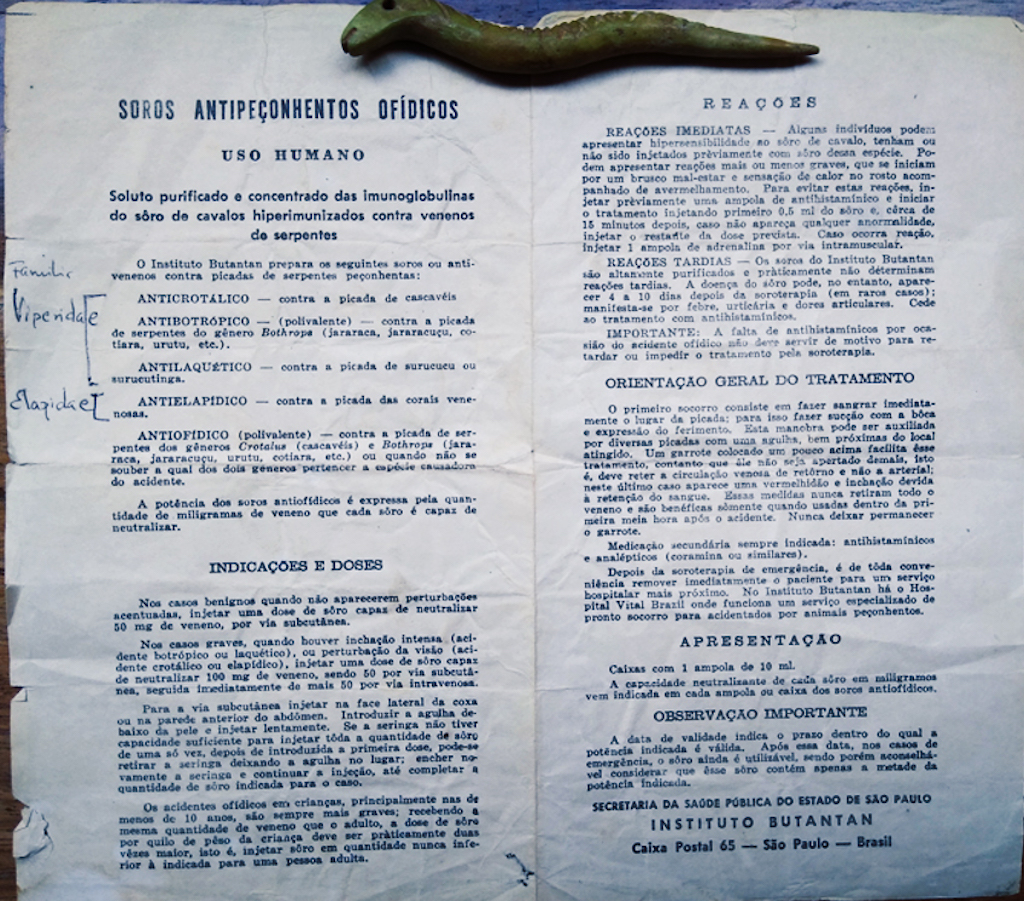
Figure 3. Photo of the instructions for use of the antivenom serum produced by the Butantan Institute of Brazil. This original copy was used in 1974 in Puerto Asís, Putumayo, by MD Hugo Sotomayor, during his rural stay in this municipality in southern Colombia, in order to complete his medical studies at the National University. Courtesy: Collection of Hugo Sotomayor.
Did a snake condom ever exist? Yes, in the 18th century. This was the name given to the bejuco del guaco, the most popular plant a little more than 200 years ago that attributed the incredible power to cure the sufferer of a venemous snakebite and to preserve oneself from its venom - that is, to protect oneself from the effects of the venom by obtaining immunity by frequently drinking its juice. The philosopher, lawyer, and acolyte of the Botanical Expedition Pedro Fermín de Vargas was the one hastened to underline its effectiveness, after venturing to verify it. In 1791 he published the
Estudio sobre el Guaco contra el Veneno de las Culebras
[11], in which he describes the antiophidic properties of the genus
Mikania (mainly
Mikania laevigata and
M. glomerata, which are commonly called guaco).
In the year 1788, this illustrious neo Granadian, who was in Mariquita, arranged the worthy mission of experimental medicine for that purpose:
“We destined this operation for May 30: After summoning on the afternoon of the previous day, a black man from a local hacienda (...) who was known as the most skilled in those dangerous experiences. The black brought with him a venomous snake, known there by the name of talla equis, because of the white spots on its back that are somewhat similar to the letter X. On the appointed day the negro took the snake into his hands and made several movements in front of the snake without it becoming restless or biting him. I judged that the negro had previously removed its fangs, or that the snake was of a nonvenomous species. However, the man made the snake open its mouth; and I saw it had all its fangs. Everybody assured me that it was one of the most venomous snakes around, so I had no doubt of the efficacy of the preservative. Consequently, I determined to do the same thing myself, and so subjected myself to the same practice that the blacks do for their cures, to obtain the fearful satisfaction of handling the snakes.
The operation that was performed on me was as follows: The negro squeezed the juice of some leaves of the guaco herb into a glass and made me drink two spoonfuls of it. He then inoculated my skin, making six incisions: One on each foot, another on the index finger and thumb of each hand, and the last two on both sides of my chest. When these small wounds bled, a little of the guaco juice was poured over the wounds, and they were rubbed with the same leaf. After this preparation the sugeto (sic) is reputed to be truly cured and in a state to catch any snake without danger. I executé (sic) it (sic) immediately.
That day not only did I initiate myself into these mysteries, but also several other people tried it who were at Mr. Mutis' house. (...) To satisfy myself in an unquestionable way of the efficacy of the Guaco herb, I took the snake into my own hands; the snake was a little restless; but the reptile did not seem to want to bite. Once I lost my fear, I handled the snake twice more in the presence of Mr. Mutis (...) and in the presence of many other people who were there for this novel experience”.
The illustrious man narrates that, in view of the good offices attributed to the plant, others dared to repeat the audacious experiment, among them, the painter Francisco Matis. Matis was wounded in his right hand during the snake-handling maneuver. However, the episode did not escalate because the black rubbed the herb on Matis´ body to stop any evil consequences.
And so, in Vargas' opinion, the myth, now converted into truth, of the benefits of the guaco that owes its name, according to his study, to a bird of the same name (probably
Herpetotheres cachinnans, a known snake eater and named as guaco in Colombia) that consumes this herb when chasing and hunting snakes in warm zones. It is said that it was the Afro-descendants of the Chocó who noticed the behavior of these birds that used the peculiar bejuco for two purposes: either to repel the venomous effects they could incur if they were bitten during the hunt or to lull their potential prey to sleep and achieve their surrender in combat.
The explanation for this protection is that the repugnant odor emanating from the body of the eater alienates the snakes so that they do not bite, or it may weaken their venom. It is not clear, however, "if the vapor of the herb works by force of the annoyance it causes (...), as a true
anguicide (sic), or by virtue of a pleasant sensation that alienates them (sic) and makes them forget their natural ferocity". For the healers, what is a fact is that its extract must be consumed constantly - at least for five or six days every month - and that it serves as an antidote against all types of snakes.
Who would not refrain from sharing his views on the matter either was another exceptional naturalist: Jorge Tadeo Lozano. He, as part of his scientific studies published in 1808 the book
Sobre las serpientes
[12], offers notes on the natural history of these reptiles in the New Kingdom of Granada and remedies for dealing with their bites. His entry into this universe could not be less accented:
“Among the various and enjoyable themes in zoology, there is perhaps no other more beautiful and important than herpetology or the study of reptiles; and among the themes of herpetology, the theme of snakes stands out. For in this animal order, which the ordinary people do not think about except with the greatest fright and horror, the naturalist admires the diversity that nature has evolved, portents upon portents, bringing together the most contradictory things in appearance. Here is where one sees a body, apparently inert and deprived of motor limbs, which enjoys the speed of lightning, and with equal ease runs over the surface of the earth, crosses the widest lakes and mighty rivers, and rises to the top of the loftiest trees. It is here that, under the appearance of a helpless animal that seems to be at the mercy of its enemies, the gigantic buio (güio or boa) is found that, with no other weapons than its enormous length and strength, fights against our most daring and largest animals [...], and not only defeats them, but also defeats them with its own strength and swallows them whole for its sustenance. Here is where in several species of the genus Coluber (Family Colubridae) and in all those of the Crotalus (Crotalurus = rattlesnakes), is hidden the venomous dart, whose wound is mortal although so small, and which by the place it occupies in the mouth is called a fang, and because it is movable and retractable and by its figure can be compared to the nail of a cat; here it is that, without proper organs for mastication, the most active digestive virtue is found; here the oviparous and viviparous generation are seen as confused and mixed; and finally, here it is that art recognizes its impotence to imitate the brilliant fugitive shades that adorn snakes and that somehow diminish the horror that their sight inspires with the consideration of the fatal effects caused by the venom of those species that are provided with such a deadly and terrible weapon”.
With great literary flair, this marquis, who was part of the Royal Botanical Expedition of Santafé de Bogotá and was in charge of the zoological part of the expedition, described and classified some of the most surprising characteristics of these reptiles. He also made an x-ray of the physiological reactions of those bitten by snakes of different species and their way of experiencing it, according to the testimonies of victims of bites or of those who assisted them. He also offered his conjectures on the subject, among them being that humidity and warm weather worsen the situation by intensifying the active power of the venom and that this not only serves to make the snakes defend themselves or attack and eat, but also them to digest the prey they engulf.
Bandaging a little above the bitten area, burying the affected limb in a hole in the ground and remaining there for 7 or 8 hours or sucking the venom with the mouth and then spitting it out (a maneuver performed by healers who chew some herbs as a counter to avoid their own venoming) are some of the primary mechanisms described in the book to deal with an ophidian bite. The final and definitive lunge proposed is the amputation of the affected part (a practice carried out by the
afrodecendientes bozales, emphasizing the illustrious Santa Fe native) after a prior analysis of the severity with which the "deadly liquor" acts.
To these mechanical remedies, whose essential purpose is to limit as much as possible the circulation of the venom in the bloodstream and to alleviate somewhat the burden for the victim, are usually added other non-medical therapeutic tactics such as the administration of substances with a chemical effect on the venom, the blood, or another part of the body (see Chapter 9). The aim of these is to "disorganize" the venom, neutralize its activity, slow its dispersion through the body, replenish "the irritability of the nervous system" - which is indicated as the main one affected -, combat inflammation and/or resist tissue putrefaction. The remedies can be one of the above, some, or all of the above. Today we know that all these practices act against the survival of the patient, generating serious injuries, worsening their condition or, in the worst case, causing their death (see Chapter 9).
In the palette of Creole options, he mentions, not without first criticizing the capriciousness and ignorance with which charlatan healers offer therapeutic miracles: the use of oil, aguardiente, cane with gunpowder and a host of plants such as
Polygala senega (a plant that he says is effective against rattlesnake venom), native to North America
[13], the tobacco leaf, and the popular
guaco, to which not only curative but also preventive properties are attributed after drinking it in juice or cooked, as Pedro Fermín de Vargas explained in his writing. "Notwithstanding this assertion which, they say, is founded on repeated observations, and notwithstanding that it is assured that there are people cured who handle snakes with impunity, I know for a fact that a black woman who was bitten by a taya in the Bajamón hacienda and had guaco applied inside and out in very considerable portions, and in spite of the decanted virtues of this specific remedy, died miserably thirty hours after that misfortune happened to her", affirmed the marquis who was versed in chemistry due to his studies at the Royal Laboratory of Spain.
Although Jorge Tadeo Lozano praised the work of Abbé Fontana in his studies on the venom of European vipers and his experimentation with caustic potash as a powerful antidote, he recognized the difficulty of accepting this as a universal remedy, given the great ignorance about the nature of the venoms and their variability according to the origin of the animal, age, sex, and other conditions that could affect their venom (see Chapter 5). In this way he glimpsed the principle of "a specific venom, a specific serum", postulated almost a century later by Vital Brazil.
He recommended the red cinchona (Cinchona oblongifolia) and pointed out that it could be used to counteract the effects caused by snake venom since, according to the "observations of the immortal Mutis, it possesses in supreme degree an antiputrid virtue that is a powerful astringent and febrifuge tonic". He clarified, however, that this was only his conjecture and that as such, it must be validated by experiment.
Finally, he offered some guidelines for those who want to study these animals: Although they have earned the hatred of mortals, they are honorable, on the one hand, because they fulfill a function in the ecosystem where they live - such as containing the proliferation of certain pests - and on the other hand, because they attack man only if they have been provoked, voluntarily or involuntarily.
Decades later, other texts on ophiology, toxicology, clinical effects, and case studies of victims were published in the country. As part of these writings, the publications of the physician Andrés Posada Arango, his counterparts Manuel Uribe Ángel and Evaristo García, the monks Nicéforo María, Apolinar María and Daniel Julián González, the herpetologist Federico Médem, and the physicians Rodrigo Ángel, Rafael Otero, and Santiago Ayerbe stand out. These last three physicians were trained in toxicology (the science that studies toxins, which are produced by living organisms such as microorganisms, plants, and small vertebrates, as opposed to toxins that are synthetic substances harmful to living organisms), and they were the precursors of two of the most robust academic programs of study and research on the subject in the country: The Ophiology/Scorpiology Program of the Faculty of Medicine of the University of Antioquia and the Herpetological and Toxicological Research Group of the University of Cauca.
3. Between ancestral knowledge, science and living memories
The above are just a few examples of how different populations during centuries have dealt with snake bites or their possible occurrences in Colombia. Although some practices are preserved, because they are part of the idiosyncrasy of the communities, many have welcomed with great receptivity the options that science has developed in the last decades, mainly the antiophidic sera, but also the scientific research on the effectiveness of plant extracts.
In fact, this is one of the lines of study of the Ophiology/Scorpiology Program of the University of Antioquia that in the 2000s initiated several ethnobotanical studies with plants used by healers in Antioquia and Chocó (one of them was presented at the XV International Congress of Tropical Medicine and Malaria, held in Cartagena in 2000
[14]). In this study a total of 101 plant species were identified, of which 74 were tested for neutralization of the venom of the talla x snake (Bothrops asper); and of these, seven proved to be the most promising by completely inhibiting the lethal effects in mice
[15].
So-called “traditional medicine” is still deeply rooted in indigenous and Afro-Colombian populations, especially in remote and warm rural areas, where most snake accidents occur. Officially, around 4,700 cases of snakebite are reported annually (see Chapter 9), with a mortality rate of 1%. According to the analysis of clinical statistics in Colombia, of the total number of people bitten by venomous snakes in the last decade, 56% presented a mild degree of envenomation, 36% showed moderate symptoms, and the remaining 8% were severe (see Chapter 9).
It is worth clarifying that not all accidents in which a snake bites a person involve envenomation; first, because in many cases snakes are not venomous or because they have inefficient bite mechanisms or have venoms of very low toxicity for humans (see Chapters
5 and
9); and second, because around 60% of the bites of species that are venomous are warning signs
[10], i.e., they are done only to dissuade predators or scare off threats, not to inject venom.
Although in 2009 the WHO included snake envenomation in the list of neglected tropical diseases, sometime later it was removed from that classification, but in 2017 it was reincorporated
[15,16]. In Colombia there has been great interest in remedying this situation through three different mechanisms: (1) local production of antivenoms - a process for which there are records since the 1930s
[17]); (2) training of health personnel in the clinical care of ophidian accidents, provided by health authorities and physicians passionate about the subject who have been trained and have extended their knowledge; and (3) research and study of the species present in our country, the second most megadiverse on the planet.
Unfortunately, not all nations have the capacity to produce antidotes to treat snake envenomation. Colombia has this capacity, and today its antiophidic serums stand out in the American continent for their quality. Thanks to our biological richness, the antivenoms produced by the National Institute of Health accept the venoms of various ophidian species from the different Colombian regions, and with them serums are formulated that, by cross-reaction, neutralize the effect of the venoms of most of the snakes of medical interest in the country (see Chapter 6).
The following is an account of this entire snake odyssey, documented and told by the protagonists at each stage. In this timeline, constituted of course by
Bothrops asper-the cause of the greatest number of envenomings in the country- the most relevant facts of this history of venoms: love and hate are referenced. Welcome!
3.1. Timeline
-1916-: The national government, presided by José Vicente Concha, buys the Hacienda Santo Domingo, where decades later the Armero Serpentarium will operate.
Detail: According to the deed of sale, this hacienda belonged to the jurisdiction of the municipality of San Lorenzo, which years later would be called Armero in honor of the independence hero José León Armero. This property, of 1,141 hectares located in the department of Tolima, was acquired for a value of 40.00 legal gold pesos.
-1925-: Law 15 of 1925 is enacted in which the Colombian Congress authorizes the government to purchase the Samper-Martinez Laboratory as a private entity capable of meeting public health needs, among them, the production of antiophidic serum.
Detail: Article 69 of this law states: "This Laboratory will preferably prepare serums, vaccines, and other biological products to combat the infectious diseases prevalent in Colombia: rabies, snake bite, and epizootics such as anthrax, symptomatic anthrax, etc. All these products will be sold at principal and cost, except for those destined to combat infectious diseases of the poorer classes, and for epidemics, cases in which these products will be supplied free of charge. To the biological products of this Laboratory that are exported, the commercial price will be fixed".
-1937-: The Colombian government issues Decree 1578 of 1937, which in its article 78 allocates 15,000 pesos for the construction, equipping, and operation of a serpentarium to produce antiophidic serum.
-1937-: MD. Bernardo Samper Sordo, founder of the Samper-Martínez Hygiene Institute (Figure 4), the foundation of the later National Health Institute, proceeded with a vigorous impulse for the eventual production of sera and, thus, strengthened the Armero Serpentarium. The development of polyvalent antiophidic serum was established.
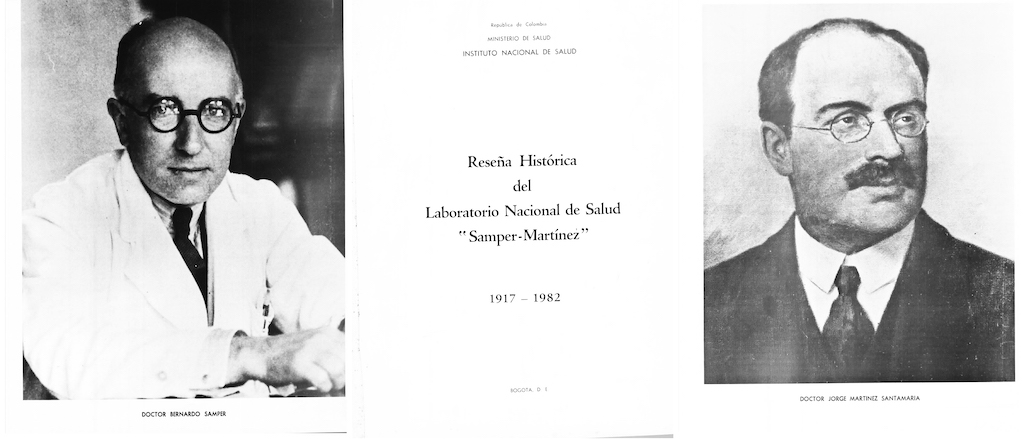
Figura 4. Photos from the book Reseña Histórica del Laboratorio Nacional de Salud MD Samper Martínez, 1917-1982. (Right) MD Bernardo Samper. (Left) Dr. Jorge Martinez Santamaria.
-1966-: The Minister of Health at the time, Juan Jacobo Muñoz, requested the Directorate of the Administrative Services to formally allocate a three-hectare plot of land, occupied by the Armero Serpentarium, to produce antiophidic serum (Figure 5). This document establishes that there was production of antiophidic serum until 1964.
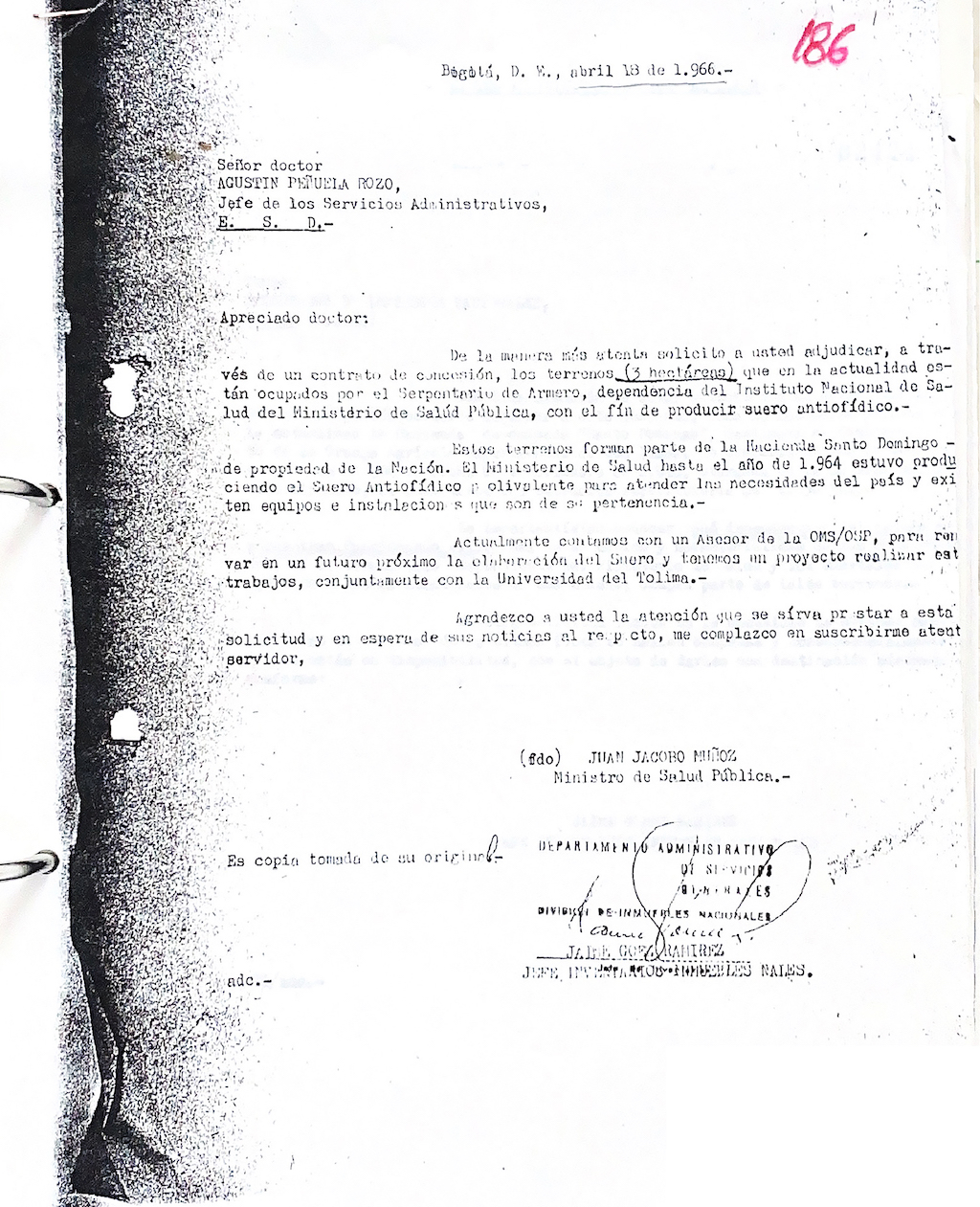
Figura 5. Letter in the dossier of documents on the serpentarium held by the INS.
-1967-: The Congress of the Republic enacted Law 39 of October 9, 1967, by means of which the nation ceded to the Department of Tolima a piece of land that would eventually be transferred in gratuitous bailment to the National Institute of Health to be used for the Armero Serpentarium.
Detail: The official publication of the act of promulgation of Law 39 of 1967 dated October 9 of that year states: the nation cedes to the "Department of Tolima a 350-hectare lot of land that was part of the former Hacienda Santo Domingo, located in the municipality of Armero, which was reserved in favor of the nation for the Army Remount." In the same document, the assignment to the Department of "the rights that may correspond to the Nation in buildings and installations constructed for the Armero Experimental Farm on the land ceded by the former to the Department, which was also part of the former Hacienda Santo Domingo" was also made.
Almost three months later, on December 29 the Department of Tolima granted to the University of Tolima the property rights and ownership of 200 hectares of the land, with the commitment to use this property for "exclusively educational, research, and extension functions carried out by the University", as stated in public deed # 2638 of 1967, Second Notary of Ibagué (Figure 6).
In 1969, the University ceded, in turn, by way of perpetual alienation, a lot of eight hectares and 59 meters from the Hacienda Santo Domingo to the so-called Armero Institute, designated as an official educational establishment with legal status in 1966 and governed by Carlos Alberto Rada Echeverry.

Figure 6. Photos of the perpetual alienation title, a lot of eight hectares and 59 meters that is detached from Hacienda Santo Domingo.
-1969-: The Armero Serpentarium was remodeled and included the construction of a laboratory for regional epidemiological research -with parasitology, entomology and arbovirus sections- and a mouse biotherium for snake feeding.
-1972-: In the Biological Products section of the then National Institute for Special Health Programs (INPES, later National Health Institute-INS), therapeutic sera were developed, including antiophidic sera; and laboratory tests (electrophoresis) were carried out to determine the potency of venoms and antivenoms. A batch of 150 vials was created, but months later production was suspended due to the lack of experience and knowledge in handling venoms, immunization protocols, and titration and production techniques. The need for international training arose.
-1974-: A tropical medical congress was held in Medellin with renowned international guests, among them, Roger Bolaños, Costa Rican microbiologist and chemist who was a speaker at a conference on ophiology in Costa Rica.
Testimony of Juan Manuel Renjifo, biologist, former coordinator of the Serum Group of the National Health Institute
"That congress was vital because it brought to the table a very important reunion: that of Miguel Guzmán and Ernesto Barbosa, INS researchers, with Roger Bolaños; all three were fellow students of the doctorate in microbiology at Tulane University, United States. The Congress was also attended by the Institute's director of parasitology, Augusto Corredor, who at the end of the event and upon his return to Bogota, began formal arrangements with the Clodomiro Picado Institute in Costa Rica to summon Professor Bolaños - who was also a consultant for the Pan American Health Organization - as an advisor for our Serum Laboratory.
I was just a recent biology graduate from the Universidad Javeriana who did his undergraduate thesis on snakes. Several people from the Institute helped me in my development and even allowed me to go several times to the Armero serpentarium to learn how to handle snakes. Since I was a little boy, I was interested in snakes because my father always had animals in the house, including snakes (Figure 7). He, Santiago Renjifo Salcedo, was a health doctor, based in Cali, and traveled through many parts of the country, mainly doing malarial studies. He was Minister of Health between 1963 and 1965.
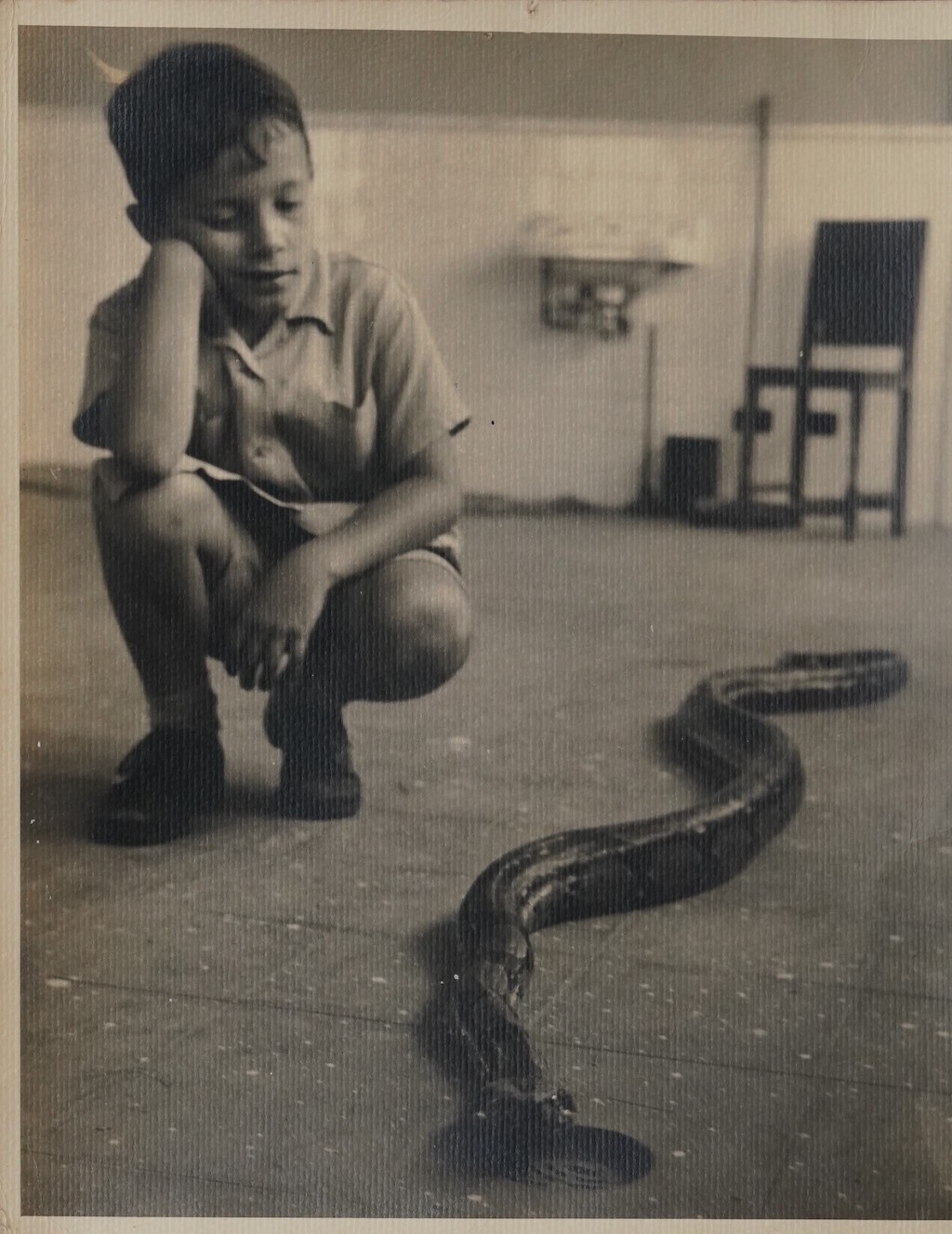
Figure 7. Juan Manuel Renjifo, eight years old, looking closely at a boa constrictor (Boa constrictor) wandering around his house. Courtesy: Juan Manuel Renjifo's private archive.
Many knowledgeable people warned me that working with these reptiles was very risky and thinking about developing sera was very complicated because attempts to date had been unsuccessful. However, I insisted for one fundamental reason: for me there is no better incentive than to be told no. As they say, if "I ask God and they don't give it to me, then that's my way".
I joined the Institute as a research assistant, and since I did well with the handling of the snakes of Armero, the directors proposed that I take charge of the production of antiophidic serums. And so, in the blink of an eye, I ended up being the coordinator of the Serum Group. Although I knew something about snakes, I had no idea about chemistry or immunology, so the first person I thought of to join the team was Guiomar Caicedo, who at that time was working in the DPT (Diphtheria, Pertussis and Tetanus) vaccine development laboratory. When I told her of my intentions, she cried with emotion".
-1974-: Roger Bolaños advised the Serum Group of the INS, given his experience and deep knowledge in the creation of antivenoms in Costa Rica (Figure 8), which he founded and was the first director of the Clodomiro Picado Institute, a world reference in the field.
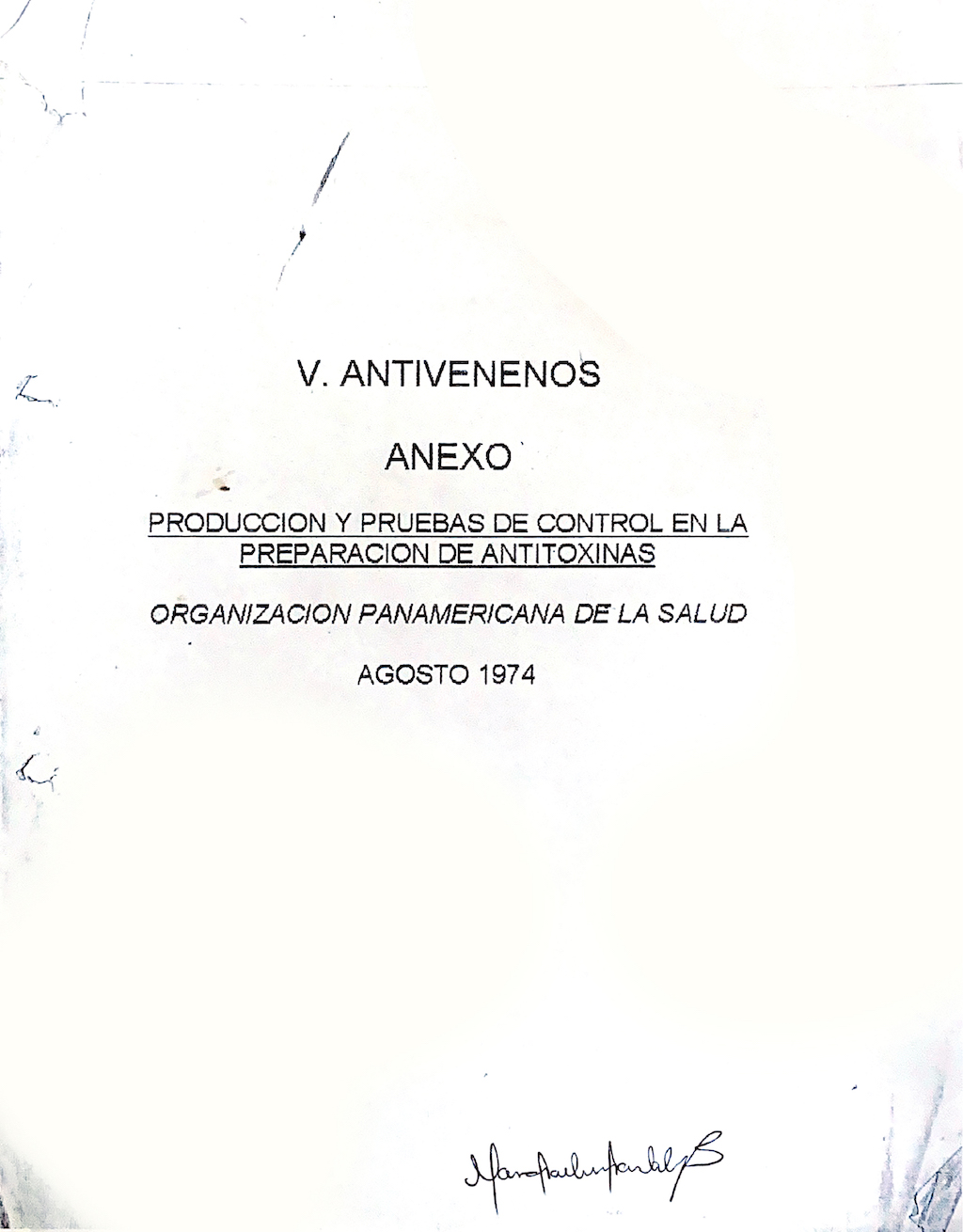
Figure 8. Photo of the report made after the consultancy of Roger Bolaños, in 1974.
Testimony of Juan Manuel Renjifo, biologist, former coordinator of the Serum Group of the National Institute of Health
"MD Bolaños' guidance proved crucial (Figure 8). It was Guiomar Caicedo who explained to him what the Institute had done so far in the production of antiophidic sera and he, very quickly, understood the scenario and trained us on what we should do and what we should not do. He toured the laboratory, checked the supplies, went to Hacienda Galindo to see the horses and to understand how the process of injecting venom and extracting blood was being done, among other things.
What we did was to dilute the venom with Freund's oil: we took a syringe with venom diluted in saline solution and another one with the oily substance and, little by little, we introduced both compounds with multiple steps and in both directions, inside the horse. A very homogeneous mixture with the consistency of toothpaste had to be achieved, which, after being injected, remained encapsulated inside the horse, allowing the progressive and slow release of the venom and the constant stimulation of the immune system.
But with Bolaños' instructions, what we did was to take sodium alginate and mix it with the liquid (dilution of venom in saline solution). Once we had a kind of gelatin, we added calcium chloride to create a softer toothpaste that releases venom not in 20 days but in 10, with a maximum release after five days. This not only shortened production times, but also allowed us to have a better immune response.
Bolaño also instructed us in the Spearman Karber technique (statistical calculation tool) to determine the lethal doses and effective or neutralizing doses and, in this way, to determine with certainty and very quickly the immune response of the horses.
During the month that Bolaños was with us at the Institute, we produced a complete batch. Then we had a second phase of training in Costa Rica, where we traveled with Guiomar to learn about the work being done at the Clodomiro Picado Institute. Upon our return, we began full production".
-1975-: The INS produces batch 4 of polyvalent antivenom for the country marked the definitive and standardized restart of the production of antiophidic serum in Colombia (Figure 9).
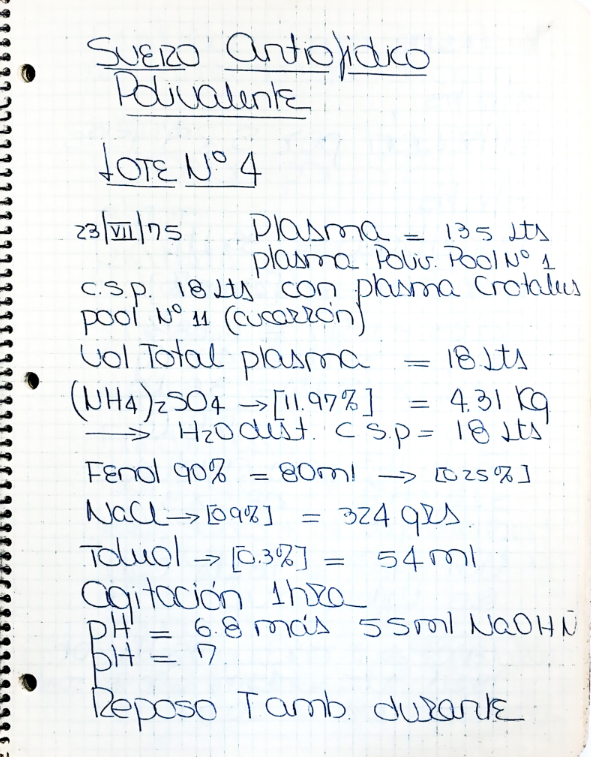
Figura 9. Image of the document recording its production. This photo shows the record made in the handwriting of bacteriologist Guiomar Caicedo in the notebook of the time of the characteristics of the plasma of Cucarrón, as one of the horses used in the production of antiophidic serum was called.
Testimony of Francisco Ruiz, current leader of the INS Serpentarium
"By 1975, our Institute had developed two types of serum: the monovalent, which neutralizes the toxic effects of the venoms of the
Bothrops group (tayas or mapanás), and the polyvalent, which counteracts the toxicity of the venoms of the
Bothrops and
Crotalus genera (rattlesnakes), the most representative in terms of ophiology in Colombia. Venom is a functional trait in snakes that has evolved according to the prey from the habitats where they live, and in this way snake venom becomes specific, according to the area where they are located. In work done by the INS, we have found that the venom of
Bothrops asper (the species that causes most accidents in our country and is distributed in the Andean, Pacific and Caribbean regions), has slightly different degrees of toxicity in the so-called lethal dose 50 (LD50), which measures the amount of a toxic substance necessary to cause the death of 50% of a set of test animals.
Additionally, there are marked differences in the other biological tests that determine the effects that cause bleeding and inflammation. Several explanations for this are included in the scientific literature, including the type of diet or prey. Moreover, a very illustrative case of this phenomenon is that of the venom of rattlesnakes that inhabit the southern United States and Central America, which cause inflammation, coagulation alterations, necrosis and, in the case of some specific species, even paralysis (neurotoxicity). In contrast, the venom of South American rattlesnakes has evolved effects that are mainly neurotoxic and occasionally also myotoxic (hemorrhage).
It is, therefore, extremely important that the venoms used as immunogens for serum production are regional or local. From the beginning, our serum group understood that it was necessary to meet the criterion of polyvalence, and in the production, development, and optimization of antivenom manufacturing, the mixtures of venoms used as immunogens were readjusted. Thus, today we use venoms of viperids (tallas, mapanás, cuatronarices, among others) from the five Colombian ecoregions. Thus, the INS antiophidic sera - the antiviperid and anticoral - have a greater neutralizing capacity than those commercialized in Colombia. Hence, one of the most valuable contributions of the Institute to the country is to enhance the serums by expanding their capacity to respond to an ophidian accident caused by a snake in any corner of the national territory".
-1975-: The INS acquired the 70-hectare property called Hacienda Galindo y Ocho Ríos, where horses were initially concentrated for the production of antiophidic serum (in addition to sheep and cattle for the production of culture media and vaccines); and, decades later, the Institute's serpentarium was also relocated (Figure 10).
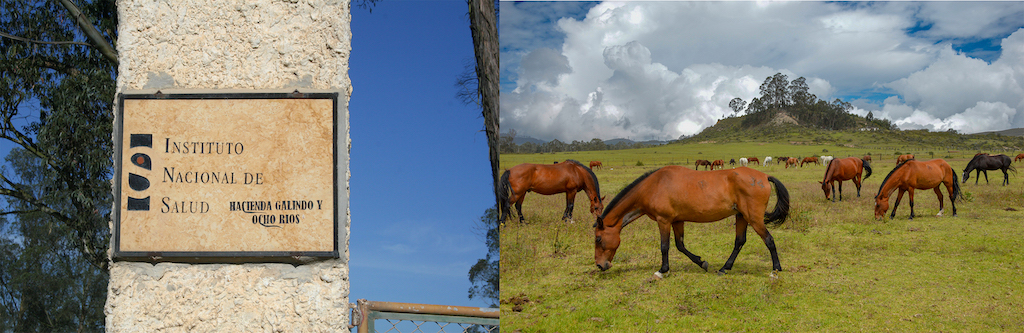
Figure 10. Hacienda Galindo y Ocho Ríos, 70 hectares, where horses were initially concentrated to produce antiophidic serum.
-1976-: First detected record of exportation of antiophidic serum. That year there was a production of 2840 vials of 10cc, of which 170 were exported to Ecuador (Figure 11).
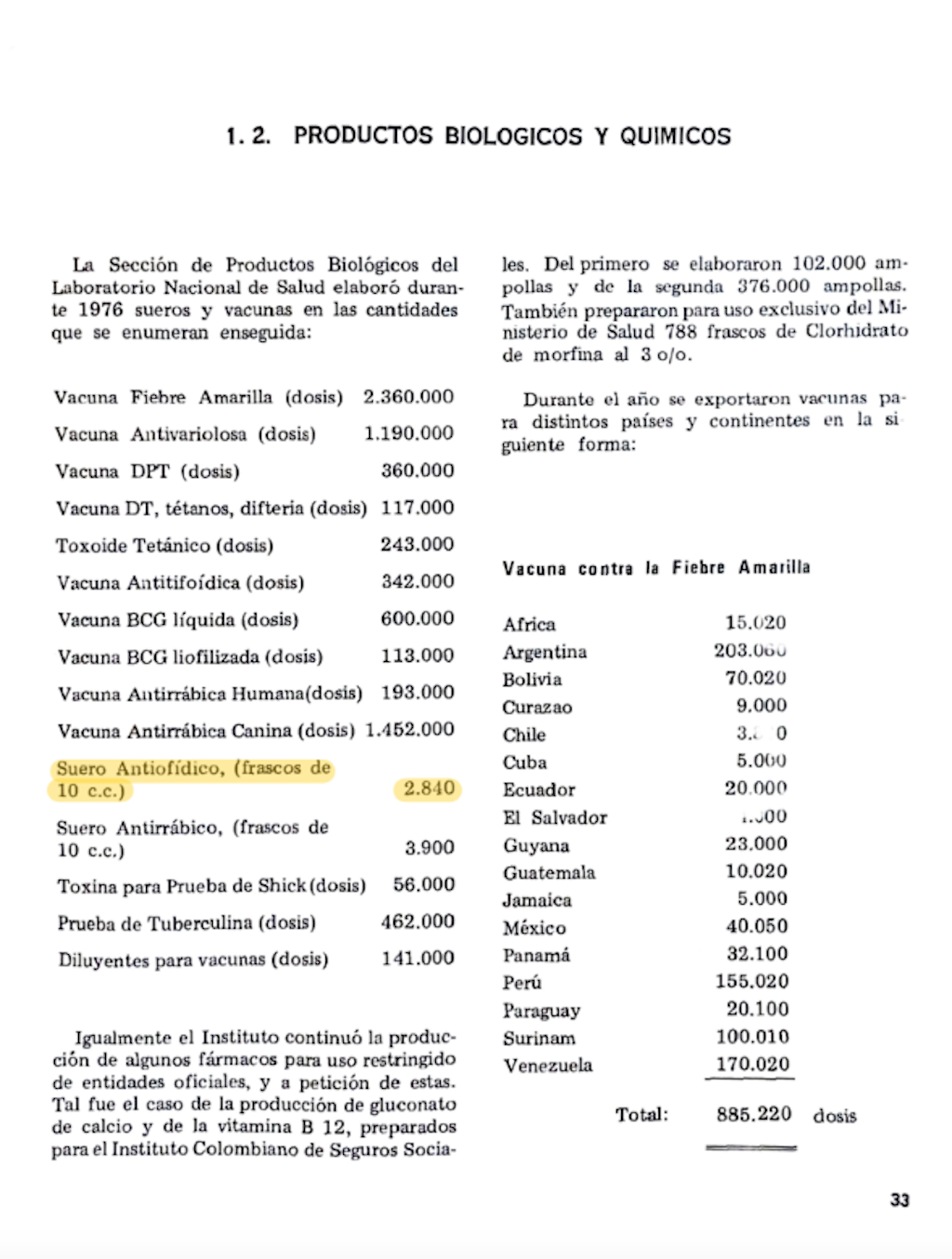
Figure 11. INS activity report in 1976.
-1978-: Lyophilization of venoms obtained from different species begins.
Detail: Since the end of the 1970s, venom extracted from snakes began to be lyophilized to favor its conservation, transport, and maintenance. This procedure consists of extracting the water from the venom by sublimation, that is, by freezing it and then evaporating it, subjecting it to a vacuum; in this way it passes from the solid to the gaseous state without passing through the liquid and, as a result, a powder is obtained that remains stable for long periods of time. Before 1978, the venoms were dried, i.e., the water was extracted from them by applying heat. "The venom is composed mainly of proteins with enzymatic action, i.e., they have the capacity to destroy other proteins or to destroy themselves. If left at room temperature between 12 and 37 degrees Celsius, it begins to denature and becomes, as Juan Manuel Renjifo used to say, panela water," explains Francisco Ruiz, leader of the Serpentarium (Figure 12).
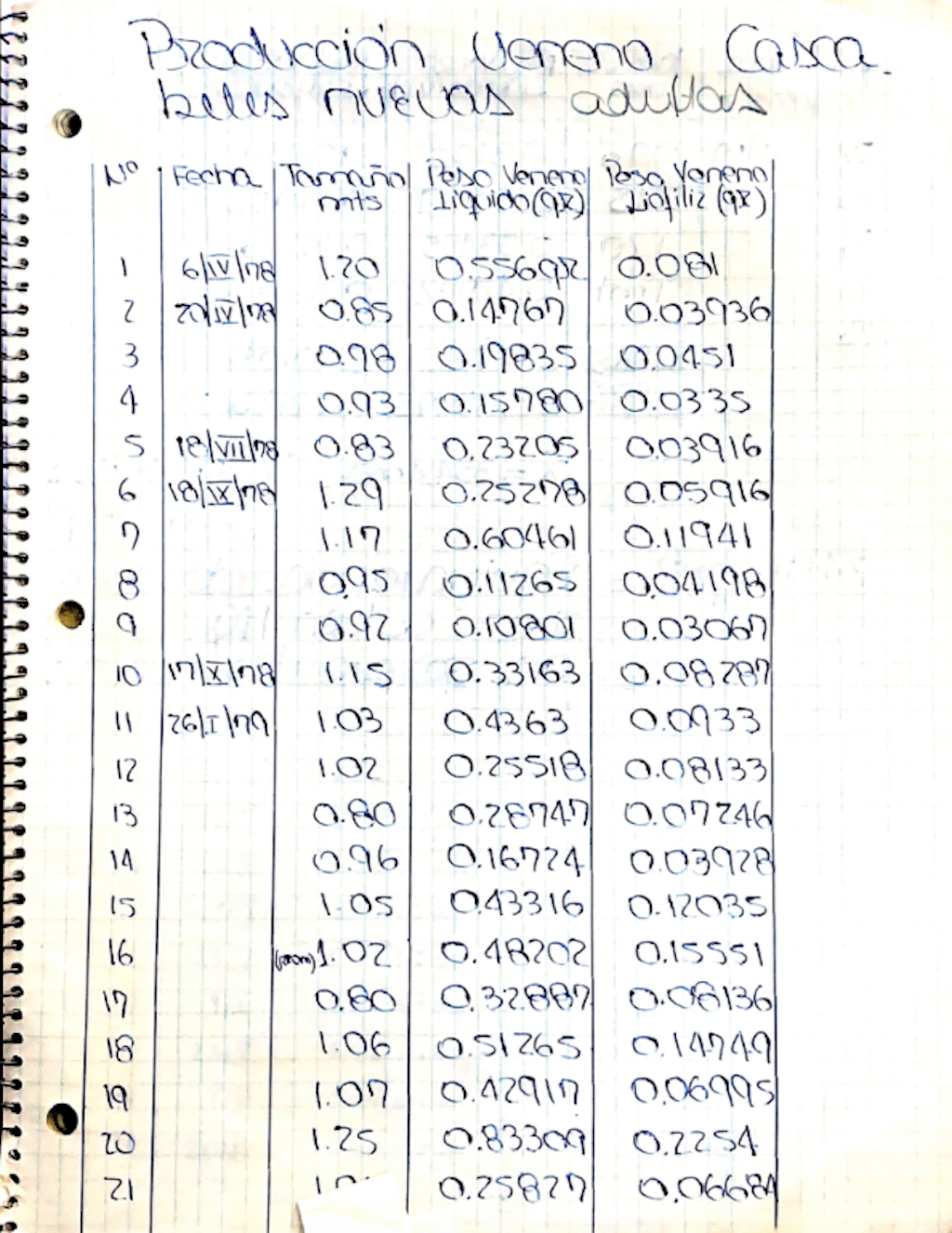
Figure 12. Photo of the production notebook of that year showing a column for recording the freeze-dried venom, in the handwriting of Guiomar Caicedo.
-1981-: Report and analysis of a case of an ophidian accident in Barranquilla.
Testimony of Santiago Ayerbe, pediatrician and toxinologist, founder of the Herpetological and Toxinological Research Group and the Biomedical Research Center of the University of Cauca
"Since I was a resident studying my specialization in pediatrics, I have studied the subject with a feverish passion and that has allowed me to help save many lives from a distance. I have a particular anecdote from 1981. At that time, I was at the Central Military Hospital in Bogota. One day the Departmental Hospital of Barranquilla called the National Health Institute requesting antiophidic anti-coral serum. Then Juan Manuel Renjifo (director of the Serum Group at that time) contacted me and said: "Santiago, they are asking us for an anti-coral serum from the Departmental Hospital of Barranquilla for a bite, but I have my doubts that it was due to a coral because although there is neurotoxicity, the patient is intubated and everything, the bite was in the back. Please, find out what it is like".
I spoke, then, not to the doctor but to the head nurse of the hospital's ICU:
-Good afternoon nurse, this is Dr. Santiago Ayerbe speaking. I was contacted by the National Health Institute about a case of an ophidian accident. Please tell me why they require anti-coral serum.
-Good afternoon, because the patient is paralyzed it is a coral venom.
-I was just informed that the bite is on the back.
-Yes, it is on the back.
-Do you happen to know how far apart the fangs are?
-Wait a minute..., it's about three to four centimeters.
-Well, for starters, there is no coral of that size on the Caribbean Coast; the only one that could have a bite three centimeters between fangs is in the Amazon. But as I know that you have a zoo in Barranquilla, run by Roberto Tinoco, the only possibility is that this person would have gone to the zoo and there they had such a snake. But it would be an exotic and very rare bite. And I don't understand why he was bitten on the back either. Did this patient come from the zoo?"
-No. He's a 12-year-old boy.
-Okay, so that's not a coral bite but a rattlesnake bite. And there are more details: a rattlesnake doesn't bite on the back unless the patient was crawling on the ground, like crawling under a fence or something, and didn't notice the animal, and as soon as it got close, it bit him. And you know what? I think that animal would have had its rattles ripped off because otherwise the boy would have heard it...unless he's deaf and that's why he didn't hear the warning sound. To me that is the cause and there is not the slightest doubt in my mind that it is a bite from a South American rattlesnake, whose venom is neurotoxic. Please, give him the antiophidic serum, because Dr. Renjifo has just informed me that the hospital has antiophidic bothropic and antichrotalic serum, and that is the one you have to give him. Give him at least six bottles.
-But doctor, the doctor here has been investigating, and the venom of the rattlesnake produces hemorrhage and swelling, but not paralysis.
-The doctor is researching in Harrison's book, from the United States, and in the part of snakebite accidents he talks about the venoming of rattlesnakes, but from North American, not South American snakes. So, in that context he is wrong. This is a neurotoxic South American rattlesnake, so please, apply the serum as I indicated.
-Well doctor, I'll let you know, thank you very much.
The next day, at 8 o'clock in the morning, I phoned the hospital. I asked to speak to the doctor, but they told me that he was currently on rounds reviewing cases, so I asked to speak to the nurse I had spoken to.
-What happened, tell me how did it go with the patient?
-How did it seem to you?, the doctor said no, that it was not a rattlesnake, that it was a coral and that he needed the anti-coral serum
-So
sumercé (Colombian idiom to say sir or madam in a respectful way), with all the love I have for you, it's not your fault. But listen to what I am going to tell you: I am in the Central Military Hospital of Bogota, I am going to try to arrange a plane to bring this patient here because they are going to kill him there. And if something happens to this patient, believe me, there is going to be a big problem. The situation is that big. The doctor is about to commit murder out of arrogance and ignorance. Tell him that and if he wants to talk to me, he can call me.
-Well doctor, thank you very much, I will.
-At eight o'clock in the evening I will call again. The nurse was delivering the shift, about to leave, and she said to me:
-Oh doctor, Oh doctor, thank goodness you called!
-Tell me, what happened?"
-Well, I told the doctor what you said, he got scared and sent me for the serum. They gave him 10 vials.
-And what happened?
-Well, right away the patient started to open his eyes and to move. He was fighting with the tube and we extubated him.
-Ahh, so he recovered?
-Yes, he recovered.
-Well, tell me something, did you ask him how big the coral was?
-No, how do you think, doctor, it was like you said. The boy said it was a rattlesnake whose rattles had been torn off, and that's why he didn't hear it when he was going under the fence. I think we are going to keep the patient under observation for one more day and then he will be discharged.
-Well, I am very grateful to you because you listened to me and convinced the doctor.
This is one of the most dramatic cases I have had and it is part of the several episodes in which I have supported the Institute to solve situations derived from ophidian accidents.
When I was young, I wanted to study biology, but in Popayan there was no such career and the closest thing was medicine, so I started studying to become a doctor. In my fourth semester I saw the first case of an ophidian accident at the San José University Hospital. I was terrified by what I saw in that patient, who arrived with very advanced venoming. Nobody knew what to do or how to treat the case; they said we had to use the antiophidic serum available at the hospital, which was from the Butantan Institute, but they did not know how to use it, not even if it should be applied intramuscularly, intravenously, or subcutaneously. And when a professor was consulted, he only managed to say that he should look in his medical books because he really did not have much experience. A little more than 12 hours later the patient died. At that moment I understood my parents' concern when they warned me as a child to stay away from snakes.
Sometime later, I began to specialize in pediatrics. It was 1977 and one day, while I was doing my hematology rotation, the head of the department, MD Alejandro Vasquez Godoy, a Chilean, told me that I had to do a research project during the four months of my rotation. We were discussing what I was going to work on when a colleague from internal medicine who had already been in the department for 15 days came in and the professor asked him about his work on ophidic accidents. He answered: "I am working on it, professor, I think I have something for next week". When I heard that, all the lights went on, and from that moment on my life began to take a 180-degree turn. It caught my attention and I dared to ask:
-Doctor, are you going to do a paper on ophidian accidents?
-Yes, Santiago. I am Chilean and in Chile there are no venomous snakes. When I studied hematology in the United States, I learned something about that because there are venous snakes there, but I am totally unaware of what is happening here, and I want us to start researching on that subject.
-Is it possible for my partner and I to work on it?
-Why, does it attract your attention, do you like the subject?"
-Doctor, I don't like it. It fascinates me.
-And what do you know about snakes?
-Nothing, absolutely nothing; but I, if you authorize me, very soon I will be talking to you about snakes, and in another language. Then he called his colleague and asked him if he could admit me to his work, to which he immediately answered yes. I thanked the doctor, and when I talked to my colleague, he told me that he had not really done anything because he was not interested; he thought the subject was a brick. I simply told him not to worry, that we were going to do the job. I told him what I had in mind about how to carry out the study, and he was fine with that. I immediately went to the hospital archive and asked the coordinator, who was a friend of mine, to help me get the medical records of ophidian accidents for the last five years. At that time there was nothing systematized, but the truth is that in a matter of an hour she gave me a folder with 46 medical records.
I picked up those documents and went to the hematology laboratory. When Dr. Vasquez Godoy saw me he asked me what I had in my hands, and I told him. Suddenly, he opened his eyes and told me: "Hey Santiago, but you are going fast, aren't you?" And I simply told him: "No doctor, there is a lot to do here".
From that moment on, with my partner we began to read history by history. We made a big 'sheet' of office-size gridded sheets that we taped together and began to make a chart with different variables. I went to the Cauca Museum of Natural History to look at books and some magazines on ophiology, and there my passion for the study of the subject began to develop until I was professionally trained as a toxicologist in Brazil.
Thanks to God I have been able to help many people who consult me from many parts of the country, at any time, and for me it is a great satisfaction to be able to analyze each case and give clinical guidance (Figure 13)".
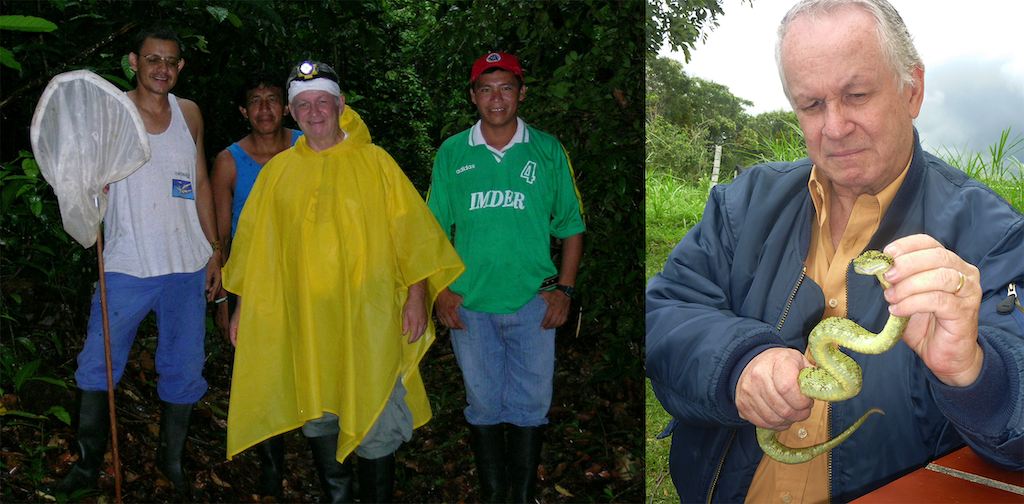
Figure 13. Left: Santiago Ayerbe searching for snakes in the Vaupes jungle with Hollman Miller (white skeleton and blue pants) and two guides from the community of Trinidad Tiquie, November 30, 2006. Right: Santiago Ayerbe handling a
Bothriechis schlegelii species complex (eyelash viper).
-1985-: A provisional serpentarium is set up at the INS headquarters in Bogotá, due to the difficulties in accessing and maintaining the Armero Serpentarium after the natural disaster that affected this municipality in Tolima (Figure 14).
Detail: The images of the destruction caused by the mud avalanche after the melting of the Nevado del Ruiz, which erupted in November 1985, remain in the memory of all Colombians. But there is one fact that passed by: the implications that this natural disaster caused in the Bernardo Samper Serpentarium in Armero, known as the Armero Serpentarium; the largest and most diverse in Colombia remained intact because the layer of mud at that point did not exceed half a meter. But the animals housed there began to starve to death because the staff in charge of it had to evacuate the area as soon as they could. The Institute was left without its primary source of obtaining venoms to produce antiophidic serum.
"A month after the tragedy, the removal of the survivors began: most of the snakes and a group of
Aotus spp monkeys used for malaria investigation," recounts the INS book Vigilantes de la Salud (Health Watchers). Where did they end up? On El Dorado Avenue in Bogota. There, at the main headquarters of the National Health Institute, a space was adapted for the sinuous creatures, to the horror of many and the delight of those who had the noble task of creating antidotes against their venom.
Although it was a provisional place, since it did not have the ideal conditions of temperature and humidity for their stay, decades passed before they were moved, in 2011, to an installation of their own: the Hacienda Galindo y Ocho Ríos, in the municipality of Bojaca, Cundinamarca (see Chapter 8).
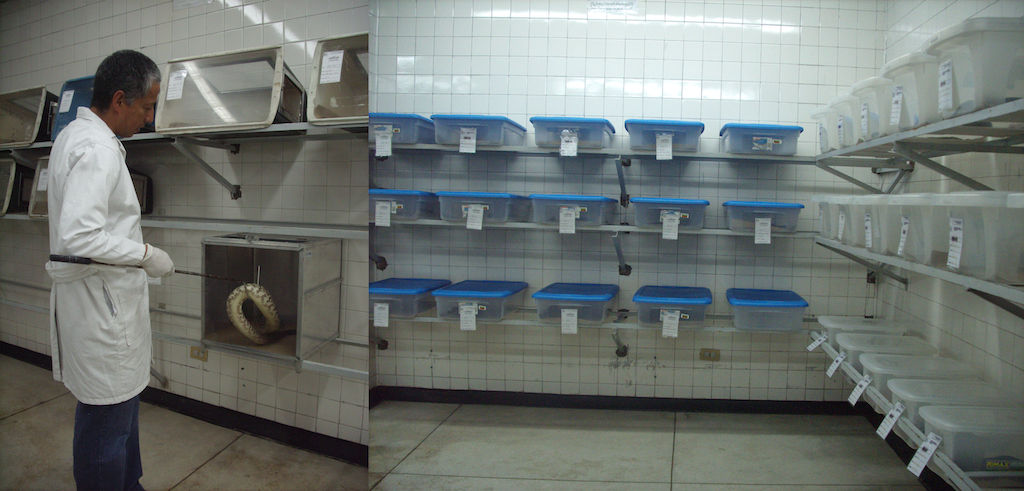
Figure 14. Photo of the provisional serpentarium located in the Bogota facilities of the INS. Originally, the snakes were housed in wooden boxes with sliding doors. Later, they were placed in aluminum boxes with acrylic lids (left), a type of shelter that was too cold for the snakes; for this reason, it was later decided to place them in plastic boxes (right) that give them greater comfort and allow for superior asepsis of their habitat in captivity.
Testimony of Juan Manuel Renjifo, former coordinator of the Serum Group of the National Health Institute
"When the avalanche happened, we went there by helicopter. Since I joined the Institute in 1974, I was in charge of the Armero Serpentarium, since that was our collection center for snakes from that region of the country. From the air I noticed that nothing had happened to the serpentarium. The mud reached only to where some of the mice were, and they had high cages; the rest, nothing.
Weeks later we moved the snakes to Bogota, and eventually I managed to keep them in separate boxes and to have air conditioning in the room where they were housed. In Armero my intention was to keep the animals in individual cages, but it was not possible because the serpentarium was built in the image and likeness of the Butantan Institute in Brazil: they were covered with transparent domes as a tourist showcase, where the snakes lived with each other. The problem with having them like that was that no sanitary control was possible; the sick ones were mixed with the healthy ones. One of our biggest headaches was the ticks they passed among them.
In the Armero Serpentarium we had specimens from San Juan de Rioseco, Lerida, Mariquita, Guayabal and all the surrounding area. But since it was also crucial to have snakes from other regions of the country - to have a variety of venoms and, therefore, antivenoms - I personally took on this task. I could not call someone on the phone and say "send me snakes"; if I did that, the answer was obvious: "you are crazy, come and catch them yourself". That's why I traveled and got to know the entire country, and in one of those trips I even found a cobra that a man had in Manizales.
I remember one time Rodrigo Angel (a physician from Antioquia with vast knowledge of ophiology in Colombia), Roger Bolaños (the founder of the Clodomiro Picado Institute of Costa Rica) and I went with him. We captured them and put them in triplex wooden boxes with sliding doors that I asked Silvio, the carpenter, to make.
Testimony of Santiago Ayerbe, pediatrician and toxicologist, founder of the Herpetological and Toxicological Research Group of the Biomedical Research Center of the University of Cauca
"I met Juan Manuel Renjifo in 1980 and he became my teacher and guide in snake research. Together we began a series of field trips to build collections. I learned a lot in biological terms about these animals. Then I, from Cauca, began to send him the snakes that I collected by air to Bogota to contribute to the production of antiophidic serums, whose neutralization capacity for the patients of this region was marvelous, because in the manufacture of these antivenoms came from local specimens. The shipments were made by Intercontinental de Aviacion, which did not charge us for the shipment, but the boxes had to be delivered two hours before the passengers arrived to avoid panic reactions. There was only one daily flight from Popayan.
Juan Manuel was a great teacher for me in ophiology, a subject for which I felt an unusual attraction from childhood. My interest in herpetology comes from those early years, particularly since 1957, when I saw a photograph of a Tyrannosaurus rex that my father had brought me from the American Museum of Natural History. In the process of researching lizards, I came across snakes; and I was struck by the fact that these animals, despite not having limbs, sometimes moved faster than the lizards themselves. I took some snakes home and that caused problems since my parents told me that they represented a great risk, and that I should dedicate myself to studying birds, which I did. However, deep inside me, that taste for snakes remained intact.
I always had some degree of difficulty learning. During my career there were medical subjects that were very difficult for me to understand, and I didn´t have a very good memory, but everything I read about ophiology I absorbed like a sponge. This was impressive, anything about snakes I understood with unique ease, as if all my life that knowledge had been waiting for me".
Testimonio de Francisco Ruiz, líder del Serpentario
"The first time I went to the Serpentarium I had an unexpected reaction: the snakes didn´t scare me, I didn´t feel panic; actually, I thought they were beautiful... their scales, their mouth, their length... The only thing I did was take notes. At that time, 1993, I was working in the Immunogenetics Laboratory of the INS Research Subdirection with primates of the genus
Aotus. But one day Juan Manuel Renjifo came to my office, smoking and scratching his head, to tell me:
-Pacho, brother, my rattlesnakes are dying.
-I know about monkeys, but nothing about snakes.
-But you're a veterinarian, how could you not know!
-Well, no, I don't know.
At that moment I had just taken blood samples from several primates; I looked at his worried face and said to him:
-"Well, I'll gladly go and take a look. I have no idea about snakes, but I could consult someone.
-Great, little brother!
He always called me "manito"(buddy). Then he took me to the Instituto's serpentarium, a space that had been provisionally adapted in 1985 due to the Armero tragedy, but it continued working there until December 2011, that is, for 26 years. There were two rooms: a large one and another one like a small basement, where there was also a small bathroom. I had never seen a snake, I am from Bogota, a pure city dweller. And since I knew nothing, I consulted the person I thought who did know: Jorge Gardeazábal from the Cali Zoo, where I had done an unforgettable internship after finishing my veterinary career at the National University, and where I found my own thing, wild animals, because I never felt comfortable with domestic animal medicine. Jorge is a wonderful, brilliant person, a great teacher and, at the time, the veterinarian who knew the most about wildlife management and medicine in the country.
I called him, described to him the snake scenario at the Institute and he gave me clear and precise instructions: 'Remember population medicine, that is what must be applied now, so separate the animals that are in good condition and leave them downstairs, in separate boxes, inside separate containers and with separate handling tongs; and classify the sick animals into less serious, more serious, and moribund. Let's take advantage of the fact that you are at the Institute, so take some swabs as samples and send them to microbiology. In the meantime, let's start with one of those broad-spectrum antibiotics.
Well, I tightened my underpants, and Juan Manuel told the snake technician to help me; he was a great man, and it is really to him that I owe my apprenticeship in snake handling. His name is Arquimedes Gonzales, a veteran paisa (how persons native from Antioquia department are called.), very judicious and a hard worker, a lover like no other of snakes, to the point that he distinguished each one, he knew their character, he knew perfectly which one was the escapist, the aggressive, the relaxed and how they should be handled. With his help and the guidance of Jorge Gardeazabal we began to treat them medically. Effectively we managed to save a group of snakes, others had died. And that was the beginning of my career as a snake catcher.
I must confess in all honesty: it was a great challenge for me to learn everything about snakes, i.e., species, distributions, and, of course, their correct handling. In the serpentarium, the ventilation system and the humidifier were deficient and had recurrent failures, so I had to spray water in the two rooms where they were located, in the morning and in the afternoon, to guarantee humidity. I often went on Saturdays to perform this task; and sometimes, I took out snakes and practiced how to hold them, by myself, and at my own risk. Fortunately, nothing ever happened to me.
Shortly afterwards, in 1994, Carlos Caceres, the veterinarian in charge of the horses used in the serum production, retired. For two years his work was taken over by other veterinarians, but eventually they also left their positions, so Juan Manuel sought me out again, in 1996, to help him. He made me a proposal.
-Pacho, you did well with the snakes. You know how they are kept and how they are milked. I want a professional who manages the process in an integral way, that is, the venoms, the snakes and the horses, and not the way we are managing it now, which is that we prepare the venoms to inject the horses, we put them in a refrigerator, the veterinarian takes them, injects the horses, after a month and a half he brings me the horse blood, we do the titration test, we tell him which horses developed the desired immunological response, and we ask him to take blood from those animals.
This is not practical, and we have communication problems with the biotherium; to avoid this, we must approach the process in an integrated manner.
-Oh, is that so?
-Yes, you do it; you can do it, that's why you are a veterinarian. If you already have your hands in snakes, I am sure that handling horses will not be difficult... Besides, I am going to tell you that the primate project is going to end, and you are going to be out of a job.
He told me all this, and I remained thoughtful. I didn't want to be left without something to do, and although I was beginning to have a passion for snakes, I had no idea about equine management because, so far, I had concentrated only on cytogenetics with nocturnal monkeys. However, I decided to accept the challenge and was endorsed by Moises Wasserman, the director at the time; so I arrived at the Hacienda Galindo y Ocho Rios, which is accessed through the Madrid Air Base until reaching the Cortes trail, in the jurisdiction of Bojaca. There was no time to join the previous veterinarian, so I received my training with the horses from the technician, Evangelista Salazar, another great human being who had learned quite well about immunizations, bleeding, and other phases inherent to the process. When the Institute bought the farm in 1975 he was the administrator, and he decided to stay working with the Institute until he retired.
I confessed to him that I knew very little about equines in general and less about hyperimmune plasma production in particular. But he, kind as always, told me: 'Don't worry doctor, I will support you in whatever you need'. The first thing he did was to show me the medical histories of the horses, and I read them judiciously. The first two years involved a lot of reading and gradually getting involved in the process, under Salazar´s guidance. His expertise in handling the horses was overwhelming. He had arms as strong as Mike Tyson's and unbelievable strength.
With Juan Manuel Renjifo, Jaime Ramirez, and Maria Cristina Forero I was learning the basics of the work with the snakes: venom collection, handling, and control, biological tests, and inoculum preparation; the work at Hacienda Galindo with the horses involved injecting venom in a controlled manner so that they develop an immune response, performing the bloodletting, and obtaining the hyperimmune plasma – all of this I owe to Salazar. Looking back, it has been a very challenging job and one that we are very proud of."
-1994-: INS officials travel to the Butantan Institute in Brazil to receive training in the production of antiophidic serum.
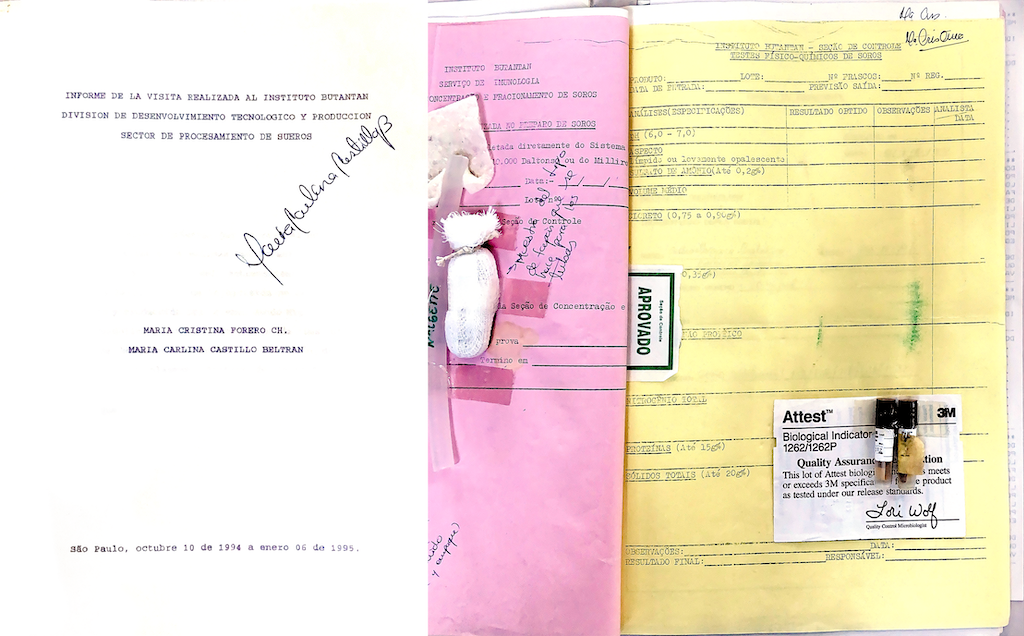
Figure 15. INS officials travel to the Butantan Institute in Brazil. (Left) Copy of the report prepared by INS Serum Group officials. (Right) Samples brought from Brazil to be used as a model for local production.
Testimony of María Carlina Castillo, coordinator of the Production and Technological Development Group of the Biologicals Production Division of the INS
"This training in production and quality control for the production of hyperimmune sera gave us a more realistic and very broad view of the degree of demand for production traceability and quality control, in compliance with good manufacturing practices. It was three months in which we had the opportunity to follow all the stages and steps involved in the production and control of hyperimmune sera.
I was 27 years old when we traveled, and it was the first time I heard only Portuguese. The first day I understood absolutely nothing, and of course at that time there were no technological tools that we know today and that are available, such as translators. In fact, the emotion I felt when I received a message in Spanish is unforgettable: it was a fax that my family had sent me with a warm greeting. Little by little, I picked up the rhythm of the language and later on I ended up with fairly fluent Portuguese (Figure 15).
At the time, Jose Roberto Marcelino was in charge of production at the Butantan Institute, and over the years we have continued to talk to each other. We met again in 2010 and 2013; he has always been a very kind person and available to support and address any concerns".
-1998-: The INS obtains the sanitary registration for 10 years for the manufacture and commercialization of antiophidic serums, from the Direction of Surveillance and Control, Division of Biochemical Products of the Ministry of Health (Figure 16).
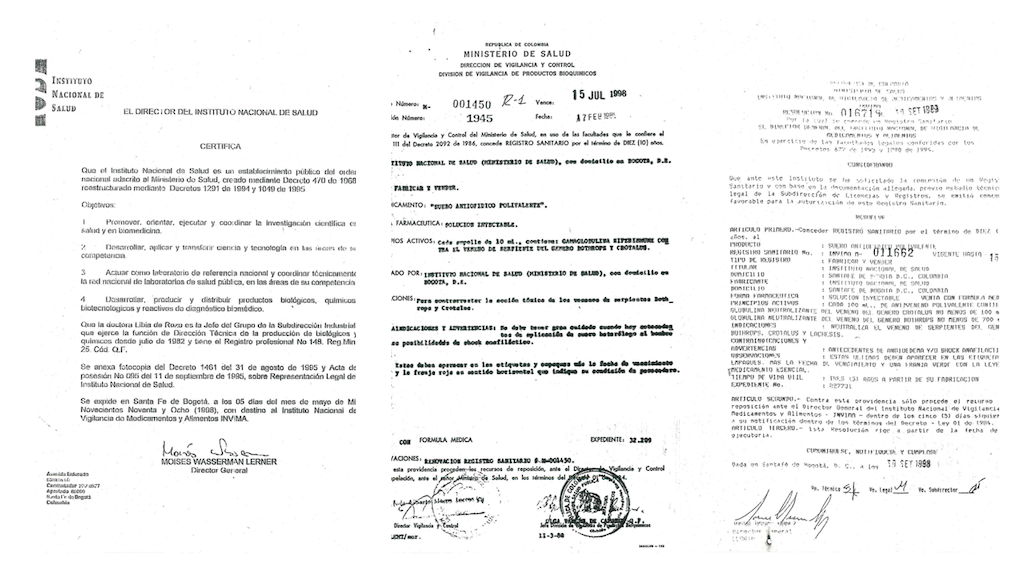
Figure 16. Photo of the documents certifying sanitary registration for 10 years to manufacture and commercialize antiophidic serums.
-2002-: The INS publishes the book
Accidente por animales venenosos, edited by the toxinologist Daniel Pineda, who describes in detail what happens in ophidian accidents and reviews the literature on venoms, types of snakes and their behaviors, treatments, and preventative mechanisms.
-2009-: The INS receives from the National Institute of Food and Drug Surveillance (INVIMA) a certificate for five years of Good Pharmaceutical Manufacturing Practices (GMP) of hyperimmune serums (including antiophidic sera; Figure 17).

Figure 17. Photo of the resolution granting the five-year Good Pharmaceutical Manufacturing Practices certification.
-2010-: The Serum Group implements negative control of equine plasma or serum in the testing scheme to determine the efficacy of antibodies produced by horses.
Detail: In the production of antiophidic serum, it is essential to perform biological tests of lethal dose fifty (LD50) that determines the toxicity of the venoms, and the effective dose fifty (ED50), intended to assess the neutralizing capacity of the serum or plasma of a horse against the control venoms, so as to know whether or not the animal can be an effective donor.
For this purpose, varying amounts of saline solution and equine plasma are mixed with the same dose of venom in several test tubes to create serial dilutions. They are then incubated at 37 degrees Celsius for the antigen-antibody (horse venom-plasma) reaction to occur. Subsequently, these mixtures are taken to the biotherium to inoculate mice.
Five mice are inoculated intraperitoneally from each tube, and each is injected with the same amount of substance. Five other mice serve as positive controls, i.e., they are injected with a combination of venom and saline solution and will therefore inevitably die. Since all the tubes of the serial dilutions have the same amount of venom, this means that the mice that survive do so because the horse's serum has developed the necessary antibodies to neutralize the venom. In this way it is possible to determine the level of titers (antibodies) that a horse is able to produce, and this power is translated into the amount of venom that neutralizes one milliliter of equine plasma.
Since 2010, negative controls have also been implemented, i.e., one group of mice is inoculated with a saline solution and another group with plasma. This verifies that these two substances are harmless for the mice and that the operator performs the intraperitoneal injection correctly, so that these animals should not die (Figure 18).
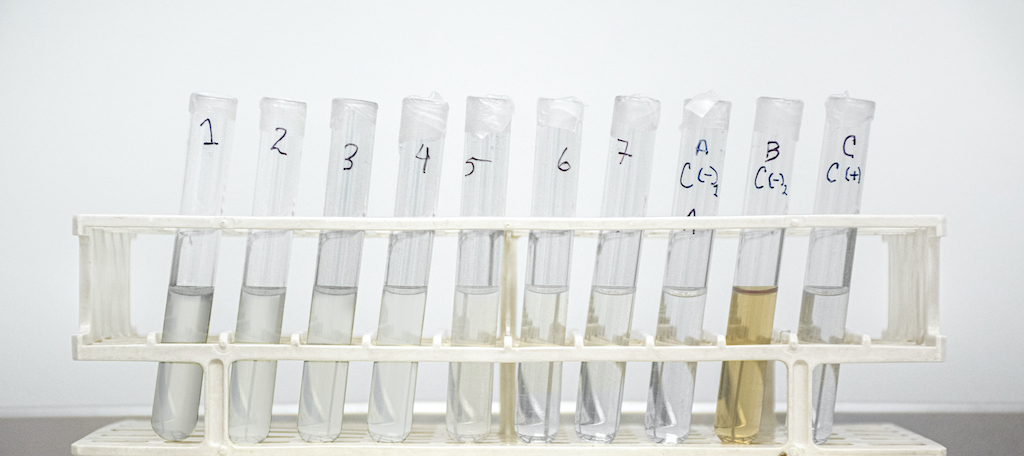
Figure 18. The test is performed in test tubes with volumes of 6 mL, each. Tubes 1 to 7 are serial dilutions with varying amounts of saline and horse serum and a fixed amount of venom. This together forms a suspension that looks milky in tube 1 and gradually decreases until tube 7 due to the reaction between the venom and the immunoglobulins (IgG) of the horse plasma so that the higher the IgG, the milkier it looks. Tube "A" has only saline and tube "B" has only horse serum, and both are the negative controls. Meanwhile, tube "C" has only venom, and is a positive control.
-2011-:The new and definitive home of all INS snakes is inaugurated: the Serpentario de la Hacienda Galindo y Ocho Rios (Figure 20).
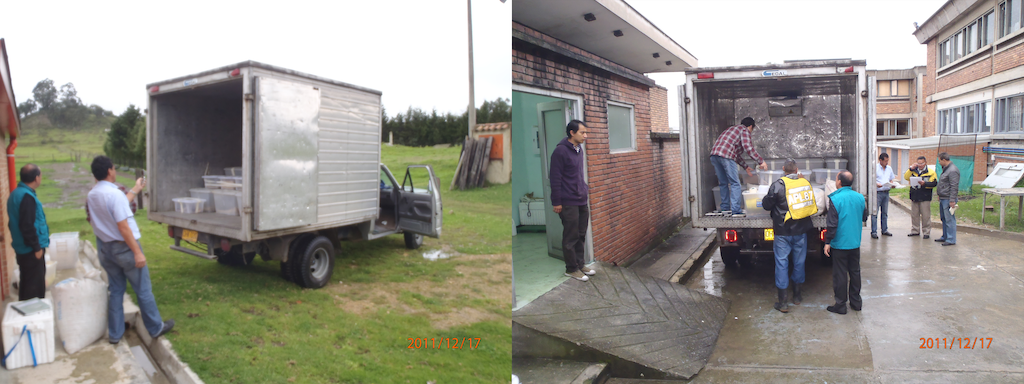
Figure 19. Photo of the transfer of the snakes from INS headquarters in Bogota (left) to Hacienda Galindo and Ocho Rios, in Bojaca (right).
Testimony of Mónica Sarmiento, veterinarian, and leader of the INS serpentarium
"The serpentarium was conceived as a laboratory, because this is where the inputs for the manufacture of serum come from. Therefore, everything is designed to maintain the aseptic conditions necessary for a biological product. Each snake lives inside a plastic box that is subjected to a rigorous process of cleaning and disinfection when it needs to be changed, for example, after receiving its physiological needs. Inside their environment, a container with water is kept for the snakes´ consumption and, in some boxes, a thermohygrometer is placed to constantly check temperature and humidity. Although in the wild many of the animals would be hidden or mimicked in natural substrates such as leaf litter, trunks, bushes, and trees, here in captivity we do not use these elements because it would be very complicated to disinfect them and change them for new ones.
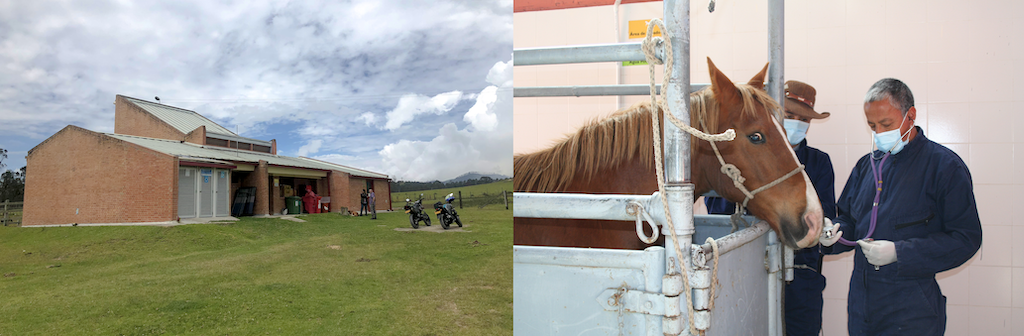
Figura 20. Panoramic view of the Serpentarium facilities at Hacienda Galindo (left). Horses destined for serum production being examined by Francisco Ruiz (right).
As replacement for more natural elements, we use a substrate that we already had standardized, a mixture of imported sterile poplar or maple chips with vermiculite, which is mixed with water to increase the relative humidity in the enclosures to reach 80% or more humidity. For the elapids we implement a deeper layer of the same substrate. This conditioning allows the coral snakes to hide and literally 'swim' within this environment, which ensures that they can hide from predators, minimizing stress and achieving greater comfort. If we did not create these conditions these species would have problems with molt retention, and they would not eat and would easily become sick and die. That is why we have made all these adaptations.
For the group of mapanas, tallas or
Bothrops in general, we use the same substrate, and for those that are arboreal, we provide them with branches to serve as perches. We have found that these adjustments have been very important because their stay in captivity has improved in time and animal welfare (see Chapter 8).
In the case of the rattlesnakes, since they do not have so many qualms about being exposed and are from dry habitats, the environments we build for them do not have vermiculite. Likewise, they are housed in the warmest part of the serpentarium that maintains an average temperature of 26 degrees Celsius.
Each time an animal enters the collection, it is quarantined and observed for three months. During this period, it is kept separate from the general population for evaluation whether it is sick or shows signs and symptoms of any disease, whether or not it is receiving food, whether it is moulting correctly, among other situations. At the end of this trimester, it is milked. If at the end of that time it shows any condition that does not compromise its life but does not evolve, it remains in quarantine. In the meantime, if there is a snake that is already part of the collection, but showing lesions -usually skin lesions-, we quarantine it until its health condition is restored (see Chapter 8).
Except for feeding days, venom milking, medical check-ups, or enclosure changes, the serpentarium is kept in the dark or in very dim light. However, every morning there is an inspection tour and recording of any news.
These are wild animals of solitary habits that are not accustomed to being handled, restrained with hooks, tongs, or hands, lifted, stretched, and having their glands squeezed to milk them. For them it is uncomfortable and highly stressful, but it is a discomfort that passes after a few hours, when they return to their primary confinement, where they can remain coiled and calm. The success of the technique consists of manipulating them as little as possible and in the shortest time possible so that these interventions do not result in illness or death. Having snakes as long-lived as the ones we have today (for example, an eight and one-half-year-old coral in captivity), we can confirm that we have greatly refined the process of keeping and maintaining the specimens under our care (see Chapter 8).
Before joining the Institute, I had no idea about snakes because I was dedicated to the veterinary medical management of horses, but learning about snakes has been incredible, very challenging, and not without risks. In fact, only four months after I started working in the serpentarium I was bitten on my left index finger by a
Bothrops asper from the Choco department. It happened on January 27, 2014.
It was a day of venom collection; I grabbed the snake, lifted it out of its box, and it bit me. It was very fast; I didn't see what happened. Obviously, I let go of the snake and my partner Carlos took care of organizing it and securing it in its box. Francisco washed my finger and massaged it so that some blood would come out. We immediately notified the ARL (notified the work risk insurance company), got the car and the antivenom that we have ready in the serpentarium and left in a hurry for the Hospital San Rafael de Facatativa; this is our medical center of reference in case of an accident in the serpentarium. We arrived after about 45 minutes and went straight to the emergency room. There, the doctor who attended me had little knowledge of snakebite, so we called MD Santiago Ayerbe. Over the phone, he guided the doctor on how to handle my case. Fortunately, the doctor who attended me was very kind and receptive to MD Ayerbe's indications.
Fortunately, the snake only bit me with one fang. At the hospital there was still a small hemorrhage from the finger, just a trickle of blood. However, the whole hand was already swollen up to the wrist. They took tests and determined that I was not clotting, so they began to administer the Institute's serum; the treatment was with 10 complete ampoules. That day they left me in intensive care as a preventive measure because I was anticoagulated. Six hours later I was examined again, and I was already clotting, but the inflammation of the hand continued, so they ordered an X-ray. The orthopedist determined that there was bone involvement, specifically of the phalanx of the finger, so he was going to schedule surgery to debride that part. However, after a second call to Dr. Ayerbe, we followed his advice not to operate at that time and so he did not authorize the procedure.
The next day I was taken down to recuperate and completed a week in the hospital, while I finished the antibiotic treatment. I was discharged, and at home I had serum sickness, which is a late and expected reaction to antivenon. Fortunately, I had no complications. A few days later, all the skin on my finger fell off, and there was a scab at the point of the bite that eventually fell off. In an evaluation by ARL they determined that I had to have a small plastic surgery to correct the defect on my finger. This they did a month later, and after about 45 days I had a small scar; but I was able to return to work with snakes. ¡I passed the test!
Testimony of Carlos Castro, animal technician at the INS serpentarium
"I have been working here at the farm for 18 years. When I started, the serpentarium functioned within the Institute, at the CAN headquarters in Bogota, and I worked exclusively on the farm in the production phase with the horses: that is, in the inoculation of venom, the titration tests to determine how effective the antibodies generated by the horse are in neutralizing the venom, the bleeding of the horses, the re-infusion of red blood cells, along with other work (Figure 21).
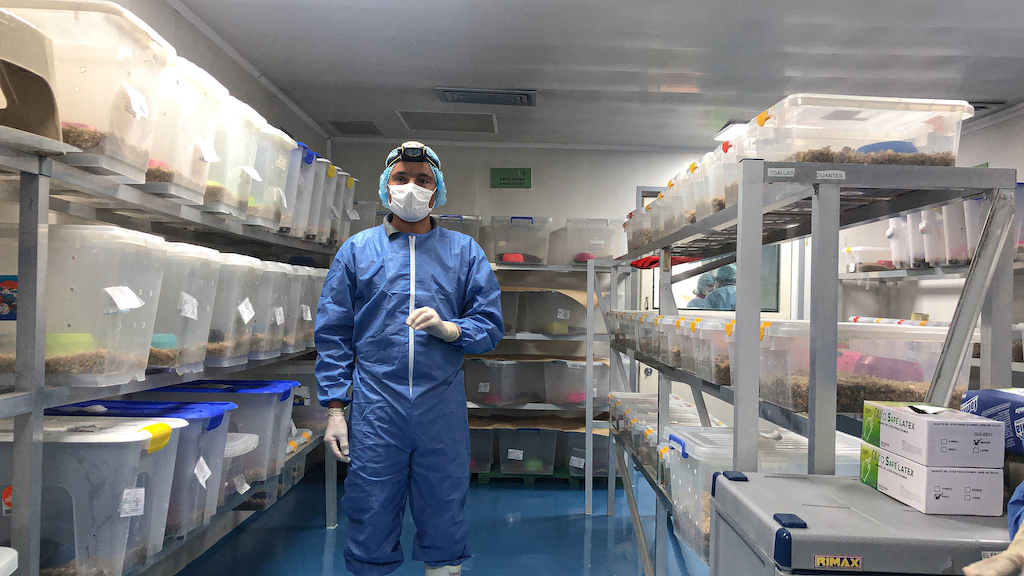
Figure 21. Carlos Castro in the current facilities of the Serpentarium at Hacienda Galindo ready to start the milking day (venom extraction).
At the beginning of 2011, when they thought of bringing the serpentarium to Hacienda Galindo, they took me to see the one at the Institute's headquarters in the CAN. I was very wary of snakes, I could not conceive of the idea of holding one in my hands, but I was very curious. So, I watched very carefully all the procedures, the handling, and the risks involved. I went twice to the Institute´s headquarters and then, at the end of that year, they finally moved the serpentarium to the Hacienda.
Mr. Francisco would come to milk the snakes and I would not go there, not for anything. But, little by little, he got me involved and taught me the whole process until I learned how to handle the snakes, and today I do the milking.
At the beginning, to catch the snakes, we immobilized them with a hook just above the head and inside the enclosures. This caused them to bite, their mouths filled with the substrate in which they live and so milking was not so effective. Sometimes, as a defense mechanism, they would expel the venom before we were able to put their mouth inside the vial, so it would end up on the floor or inside the box. To avoid this waste, I modified the technique that Mr. Francisco taught me, and for some years now what we have been doing is to restrain an animal with a clamp and hold it by the head, keeping it closed so that it does not prematurely release the venom.
With the snakes you have to be very calm and feel very safe at all times. When we are doing this work, everyone in the team is very connected; many times, we don't need to talk to say 'I'm going to open the box', 'you have to take it', 'I'm going to release it'... we are so synchronized that sometimes just a look is enough.
From the moment we handle them, anything can happen to them: from a very slight external skin wound, to a fracture of the vertebrae, to a fang injury when they bite the vial. But we are very careful, and this rarely happens. It is not for nothing that we have snakes that are several years old. Sometimes, for example, the animals hurt their gums a little during extraction, or as they are constantly changing teeth (it depends on their size and how much they are eating), many times when the new tooth pushes the old one and the old one is already loose, we have to remove it to prevent it from getting stuck. After milking them, we clean them with an antiseptic; and, in some cases, we apply antibiotic cream (see Chapter 8).
For hygiene and protection of the snakes we use latex gloves that we change between snakes; the only consideration is that they fit tightly so as not to lose grip and sensitivity. But with the small snakes, like the corals, we have refined the technique a lot. The person who handles the small snakes manipulates them 'clean-handed', that is we do not use hooks, tweezers or gloves in order to preserve greater motor skills and sensitivity and minimize the risk of mistreating them. This also gives greater security to the handler. Fortunately, to date we have not had an accident with the corals, which demonstrates the wisdom of our technique.
I live here at the Hacienda with my family, who are already very accustomed to the entire process of producing antiophidic serum. In fact, my daughters, ages 8 and 17, already know quite a bit about snakes".
-2016-: The INS, the National University of Colombia and the Ministry of Environment and Sustainable Development publish the document of the National Program for the Conservation of Snakes in Colombia (see Chapter 1), in which they address general and diagnostic aspects of the country's snakes, establishing the species in the different ecogeographic regions and project how the program for their conservation should be (Figure 22).
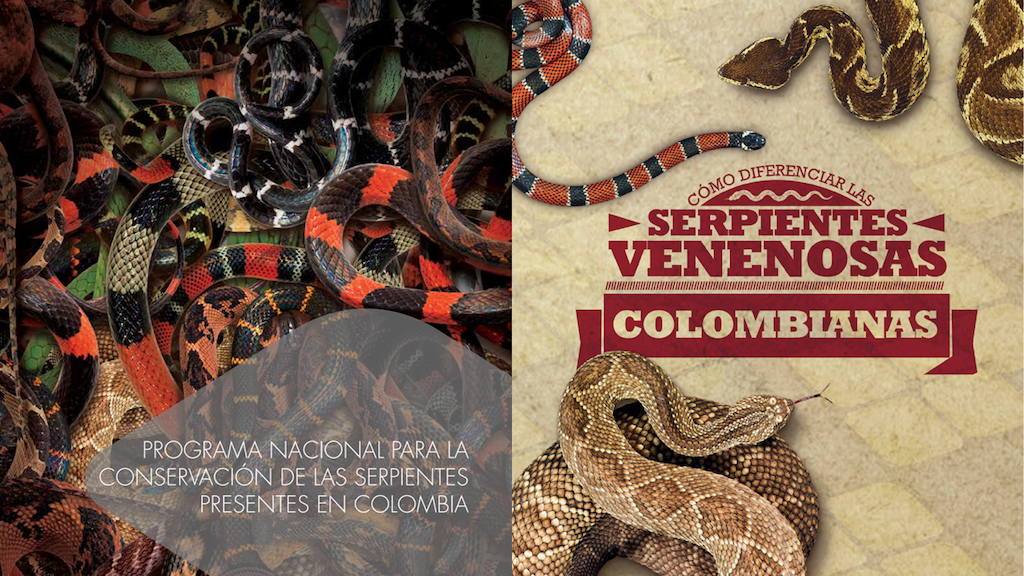
Figure 22. Covers of the
National Program for the Conservation of Snakes in Colombia and the guide for the differentiation of venomous snakes in Colombia.
-2016-: INS creates the first polyvalent anticoral serum. With the manufacture of 363 vials begins the uninterrupted production of this antiophidic serum in the country.
Testimony of Francisco Ruiz, leader of the Serpentarium
"The production of anticoral serum had always been a myth, like everything with snakes, largely because corals are much more difficult to handle from their capture to their handling, including their captivity. At this point in my life, I have collected about 300 snakes in the field, and of those, only two have been coralsnakes. There are 30 or so different species and they are terribly toxic; if you don't have the serum next to you, it's deadly.
Developing this antivenom was one of our major objectives, so we started by doing two exercises: the first was to ask many biologists and herpetologists which is the most representative coral in terms of ophidian accidents in the country. For this species we have to redouble our efforts to make the serum. The second was to investigate among medical specialists in the field, which is the snake of this type that generates more accidents according to the patients they receive. For this information we went to two experts: Santiago Ayerbe, who is from Cauca, and Rafael Otero, from San Gil (Santander), although all his professional life was carried out at the University of Antioquia.
After talking to many people, we concluded that there were four species of corals that cause the most accidents: two from the trans-Andean region (the Andean, Atlantic and Pacific zones), that is, everything in the western part of the country, where most of the Colombian population is distributed, and two from the eastern part of the country, the cis-Andean region (Orinoco and Amazon). Of the former, the two most representative snakes are the
Micrurus dumerilii and the
Micrurus mipartitus-the redtail coralsnake -, and of the latter are the
Micrurus isozonus and the
Micrurus surinamensis. The latter is the water coral, and because of its size and the toxicity of its venom it is considered one of the deadliest in Colombia.
So, with the venoms that Juan Manuel Renjifo had left in our bank of venoms, added to those collected by our group in recent years, we began to think with María Carlina Castillo how we were going to mix them and, what was more critical, how much we were going to inoculate each horse.
After scratching our heads, writing to the Brazilians, who obviously had their recipe and are jealous of it, and the same with the Costa Ricans, we came up with a number according to our calculations. It took us a week to figure out the formulation. We injected the horses with venom, and I was at the farm, from 6 am, for 23 days straight, observing the process. We did three venom injections, drew blood, went to titer and we were like little kids in secrecy: we locked ourselves in the lab and did the tests until EUREKA! All four horses gave titers for the venoms we injected into them. We figured it out! That's how, by the beginning of 2016, we made the first batch with 363 vials of polyvalent anticoral serum from the National Institute of Health (Figure 23).
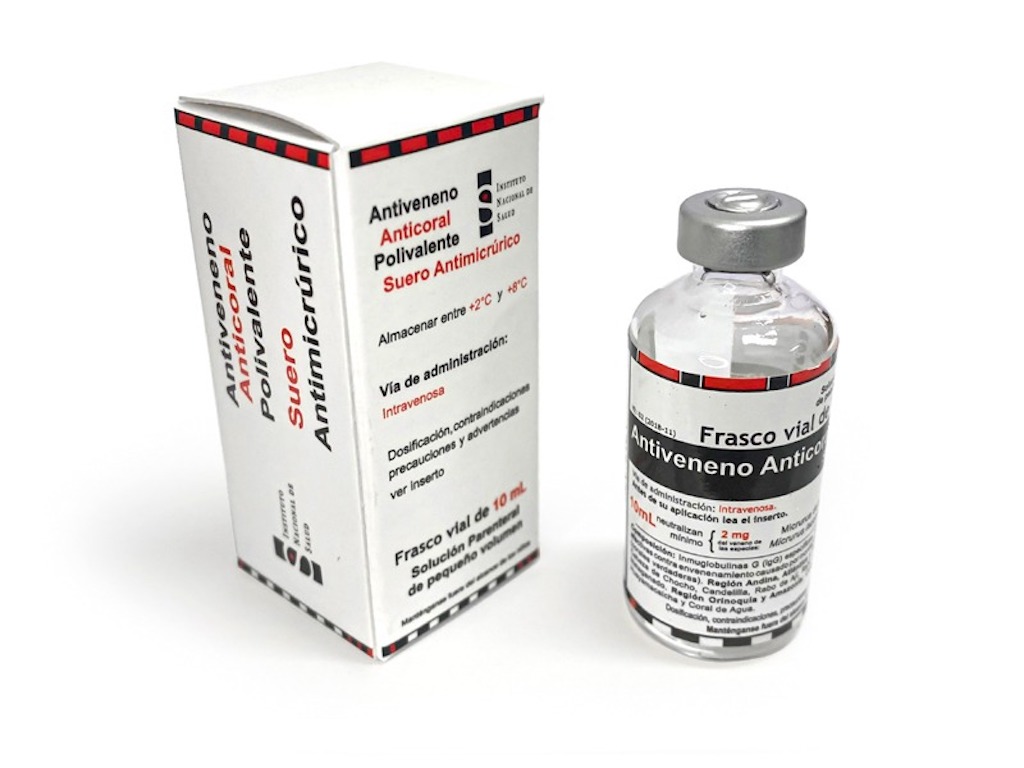
Figure 23. Second batch of polyvalent anticoral serum produced by INS.
We were filled with excitement and fear because, although all the preclinical tests performed were reliable, we did not know what the reaction would be for people. I was very anxious with the first patient who was given our antiophidic serum. We followed his case very closely and had direct communication with him; fortunately, he responded very well. I also saw the second patient; and, in addition, I accompanied the treating toxicologists at the Hospital San José de la FUCS, where he had been rereferred from La Mesa, Cundinamarca, due to the bite of a redtail coral snake (Micrurus mipartitus). In 48 hours, the patient had an impressive change after the application of our anticoral serum, and this proved its enormous efficacy. Since then, every year we receive messages from general practitioners, emergency physicians, and toxicologists sharing with us their successful experiences in the treatment of ophidian accidents due to elapid bites. We made some adjustments and now we are in the final phase of registration with INVIMA".
Testimony of Rafael Otero, pediatrician and toxinologist, founder of the Ophidism and Scorpionism Project in Antioquia and Chocó, School of Medicine, University of Antioquia
"Coral venoms are slow-acting, and by slow I mean two hours after the bite for the clinical picture to set in when different symptoms usually appear: the eyelids droop, swallowing and breathing become difficult, there is weakness in the extremities; and, finally, respiratory arrest occurs, which can happen from 6 to 12 hours, depending on whether it is a child or an adult. For this reason, treatment should ideally be applied during the first two hours, as this is the best way to obtain the best results.
The anticoral antivenoms that have been produced in Colombia since 2016 are the result of experimentation in Brazil or Costa Rica with similar antivenoms against Micrurus, the genus of venomous snakes called corals. And these domestically produced sera have nothing to envy to foreign ones in terms of neutralizing efficacy. The INS polyvalent antivenom fills a great void that existed in Colombia due to coral accidents. It is very powerful and covers several species".
Testimony of Santiago Ayerbe, pediatrician and toxicologist, founder of the Herpetological and Toxicological Research Group of the Biomedical Research Center of the University of Cauca
"Coral venom is a very difficult venom to obtain because they are animals with very small fangs, one millimeter or less. Only the largest ones have fangs of two millimeters; and that is why, in general, milking them is extremely difficult. Of course they are potent venoms, but the amount obtained is minimal and the host, which is the horse, needs enough venom to be able to recognize it and produce antibodies. Otherwise, one can hardly have a neutralizing effect. That is the problem with coralsankes, and it is not only here, but in all America.
In Brazil and Costa Rica there are recognition problems, that is, when doing in vitro tests, the venom is recognized, but the antibody is not produced. The anti-coral serum that did prove to have an adequate or recognized neutralizing capacity was that of the venom of the capuchin coralsnake (Micrurus dumerilii), a coral that here in Colombia has four subspecies and occupies the second place in coral ophidian accidents, since the first place is held by the redtail coral snake (Micrurus mipartitus), with 4 or 5 subspecies that will soon be elevated to species.
The Institute produces the most potent anticoral antivenom in the Americas, but it is used only for the species of the northern part of South America, i.e., Colombia, Ecuador, Peru, Venezuela, and some of Brazil, since the venoms used in its manufacture are from those regions. It is also used for Panama and Costa Rica because the
Micrurus multifasciatus, whose venom is almost identical to that of the redtail coralsnake, reaches there. This serum is the one with the greatest neutralization capacity".
-2016-: Forty years after it was produced, a laboratory study was carried out on a sample of the antiophidic serum of lot 12, manufactured in October 1976, the oldest of its own manufacture kept by the INS.
Testimony of Francisco Ruiz, leader of the Serpentarium
"This is the oldest preserved vial of monovalent antiophidic serum produced by the National Institute of Health (Figure 24). It is lot 12, manufactured in 1976, when the serum group was headed by Juan Manuel Renjifo.
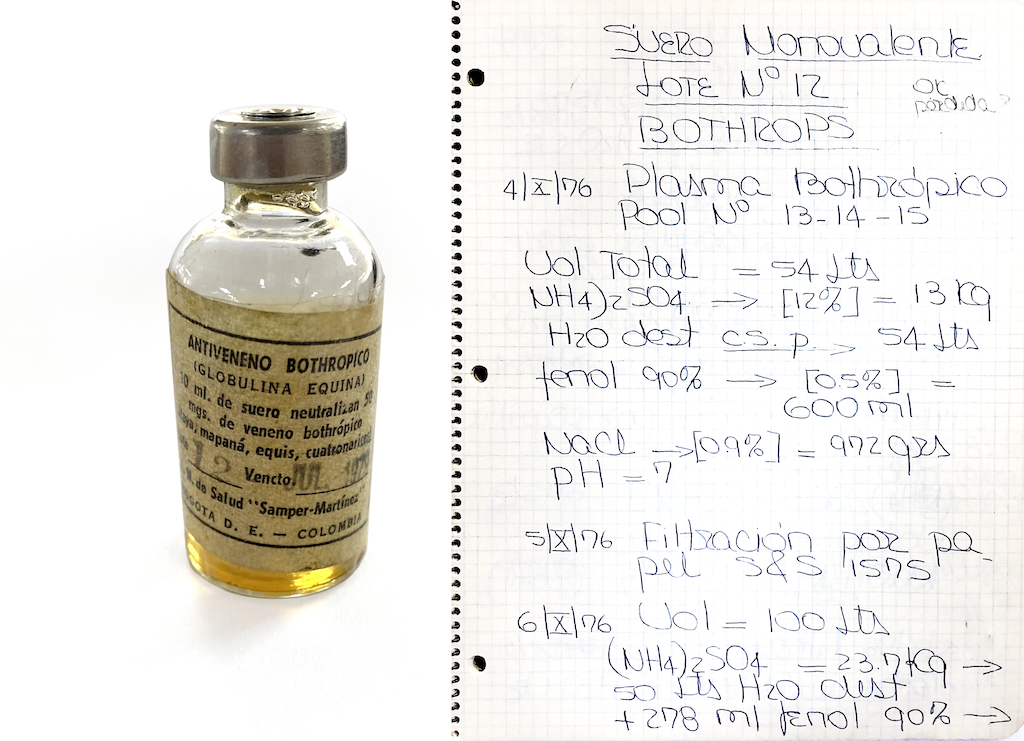
Figure 24. (Left) Polyvalent antiophidic serum produced in the 1970s, corresponding to lot 12. (Right) Photo of the 1976 production notebook showing the lot of the vial containing the antivenom, in the handwriting of Guiomar Caicedo.
This serum was recovered thanks to the fact that one day, towards the end of 2009, a doctor came to the Institute's facilities in the CAN to give it to me personally two vials. According to what he told me, his father used to buy the serums at the Institute and kept them frozen to better preserve them, and when he died they were found inside the refrigerator of his farm. He thought that, instead of throwing them away, the Institute would be interested in having them. He brought us two vials. We tried one and after so many years the serum still neutralized. Juan Manuel used to use a phrase that I will never forget: 'the serum is very grateful'. And indeed, this bottle shows it".
Testimony of Maria Carlina Castillo, coordinator of the Production and Technological Development Group of the Biologicals Production Division of the INS
"One of the vials received by the INS in 2016, with testing optimized to the maximum, was subjected to electrophoresis analysis, protein quantification, and the most critical test—the neutralization titer or potency. The result was conclusive: the serum still maintained its titers 40 years later. I have always said that the stability of the sera that INS produces is very high because not everybody produces with the same stringency, with the same neutralizing capacity or with the same compliance with the regulatory framework. The INS do not commercialize any batch of antivenom if it does not have the certificate of approval from INVIMA as the regulatory body (Figure 25)".
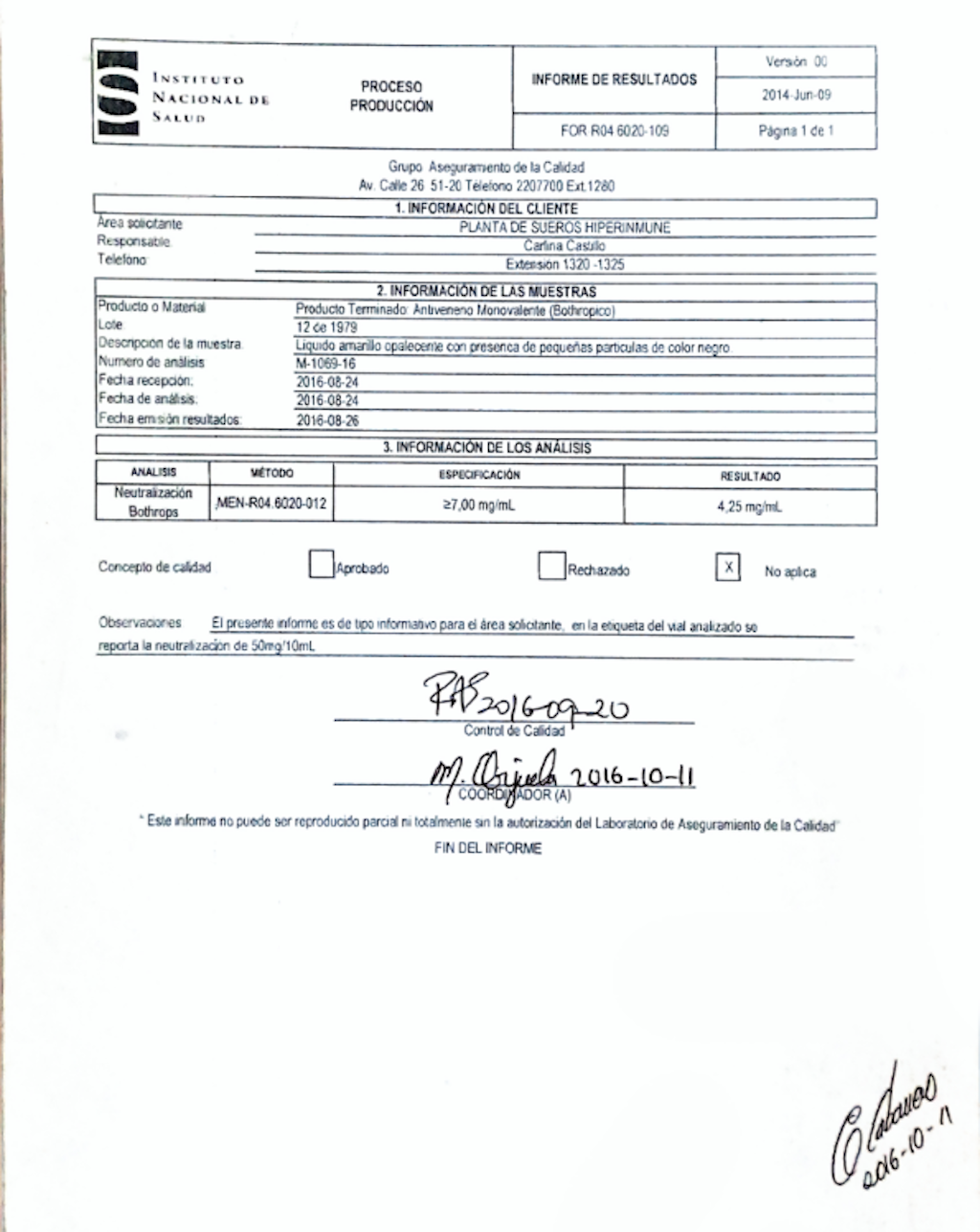
Figure 25. Photo of the result of the neutralization titer test performed on lot 12. Although this document states that this result is from lot 12 of 1979, in reality this year corresponds to the expiration date of the vial. Its production was in 1976.
-2017-: For the second time, INS receives from the Instituto Nacional de Vigilancia de Medicamentos y Alimentos (INVIMA) the certificate for 18 months of Good Pharmaceutical Manufacturing Practices (GMP) of the polyvalent antiophidic serum and polyvalent anticoral antivenom.
-2020-: The U.S. Armed Forces publish a global management guide in case their members suffer ophidian accidents, and in it they determine the use of the antivenoms created by INS as first-line treatment, in South and Central America.
Detail: The guide for the evaluation and treatment of people who have suffered ophidian venoming hosted by the U.S. Armed Forces establishes, in each region of the world, the protocol to be followed. According to this document, to counteract neurotoxic venoms in South America, the polyvalent anticoral anti-venom produced by the National Institute of Health of Colombia constitutes the first line of action recommended to deal with a case of any severity (page 60 and 64
[18]).
-2021-: -: Once again, the Instituto Nacional de Vigilancia de Medicamentos y Ali-mentos (INVIMA) certifies INS in Good Pharmaceutical Manufacturing Practices (GMP) for the manufacture of polyvalent antiophidic serum and polyvalent anticoral antivenom.
-2021-: The Institute is conducting lyophilization tests on polyvalent antiophidic serum (Figure 26).
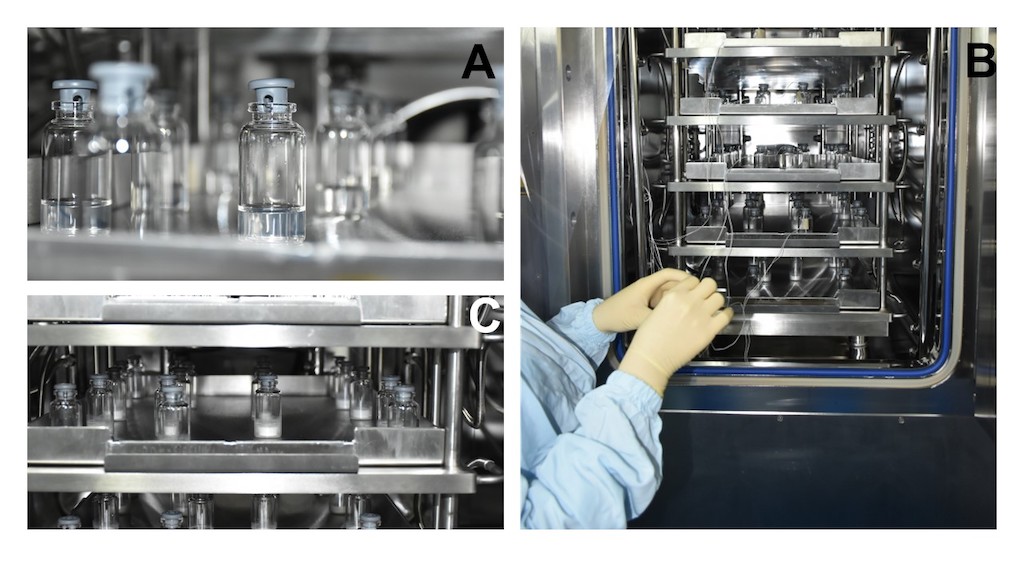
Figura 26. Lyophilization of antiophidic serum. (A) Antiophidic serum before lyophilization. (B) Antiophidic serum in lyophilization chamber. (C) Lyophilized antiophidic serum.
Testimony of Maria Carlina Castillo, coordinator of the Production and Technological Development Group of the Biologicals Production Division of the INS
"Currently, we are doing lyophilization tests, and we are almost ready to make our pilot batches. The challenge is to maintain the same neutralizing capacity, that is, 7 milligrams of antivenom per milliliter of venom. We are planning to manufacture a lyophilized fraction to satisfy a small market of people who want it in that presentation, but we will keep our liquid sera, as all our biological hyperimmune products are today.
With respect to antivenoms, I can say that our serum, if kept at 37 degrees Celsius day and night or frozen, starts to lower its titer (potency) after about six months. The first thing that is affected is its appearance, because it becomes milky, but it does not lose its neutralizing capacity. We also have evidence that at about 20 degrees in the shade, the product is maintained for the entire shelf life, which is three years in the case of the polyvalent bothropic antiophidic serum, according to the authorization of the current sanitary registration.
The Institute has a program for the study of stability, and for this purpose different batches are kept for the entire shelf life. Initially, all of them were tested at 0, 1, 2, 3, 6, 9, 18, 24, 36 and 48 months after manufacture. Nowadays, we are spreading them out a little further - we perform them at 0, 3, 6, 12, 18, 24, 36 and 48 months - in order to confirm the overall characteristics of the product. Sterility, safety, protein, phenol, chloride, and other tests are performed to ensure that the same conditions of efficacy and safety are maintained.
4. Looking to the future
Lyophilization is the most recent chapter in the history of the production and optimization of antiophidic sera, a process that has been around for more than a century and which emerged in Colombia in the 1930s.
There are technologies that will undoubtedly evolve the development of anti-venoms and allow the use of different methodologies, such as bacteriophages, transcriptomics, or recombinant venoms (see Chapter 6). However, they will take a long time to analyze, evaluate and implement because of their complexity and cost. Not surprisingly, Brazil, Costa Rica, Mexico, England, and Japan, to name but a few countries, are leading the way in the study and development of sera, following in the footsteps of the French infectologist Albert Calmette and other visionary scientists of the late nineteenth and early twentieth centuries.
As a result, the National Institute of Health has strengthened, especially in the last decade, the technical equipment and infrastructure necessary to manufacture safe and effective biological serums against envenomation by the bite of various snake species. Today it has a production capacity that overcome 50,000 vials per year; however, this could easily be doubled if required, to fulfill the mission that snakebite accidents are no longer a neglected tropical disease, neither in Colombia nor in the world.